Retirement
When can I actually retire?
How to turn savings, spending, and Social Security into an honest retirement age, not a guess.
Most retirement advice tells you how much you should be saving. That’s a fair question, but it isn’t the one most people are actually asking. What you want to know is when you can stop: given what you’ve saved, what your life costs, and what Social Security adds later, at what age do the numbers hold up?
What “ready” actually means in numbers
Being ready to retire isn’t an age. It’s the point where three numbers fit together: what your life costs each year, what you’ve saved, and what income keeps coming in once the paychecks stop.
- Your annual spending. Your real cost of living, once you’re honest about it: housing, food, insurance, travel, the car you’ll eventually replace. This is the number everything else has to cover.
- Your savings, and where they sit. You can reach a brokerage account at any age. A 401(k) or IRA is basically locked until your access age. Two people with the same total saved can retire years apart, just because of how it’s divided between the two.
- Income that shows up later. Social Security, a pension, rental income. Every dollar of it is one your savings don’t have to produce.
The 25x rule of thumb
The math: what your savings must cover
From the year you retire onward, ifso runs the same loop a careful planner would run by hand. Each year your expenses come due, bumped up by inflation. Your portfolio pays them. Taxes come out of any withdrawal that owes them. Whatever’s left keeps growing.
There are two ways to size that annual withdrawal, and ifso does both. By default it uses a safe withdrawal rate: each year you pull a set percentage of the portfolio (4% unless you change it) on top of your expenses and loan payments. The other option is expenses-only, so you withdraw exactly what your life costs that year and nothing extra. The first is how most retirement research frames it; the second is closer to how retirees actually behave.
Taxes are usually where hand-math gives up. A dollar out of a traditional 401(k) gets taxed as ordinary income. A dollar you raise by selling in a brokerage account is only taxed on the gain. ifso grosses up each withdrawal so your spending is covered after tax, which means your portfolio drains a little faster than a spreadsheet that ignores taxes would suggest. Over a thirty-year retirement, that gap adds up.
The bridge years
Social Security changes the picture more than you think
You can claim Social Security any time between 62 and 70, and the age you pick resets the size of your check for good. It’s an exact formula, not a rough estimate. Against a full retirement age of 67 (anyone born in 1960 or later), claiming at 62 gives you 70% of your full benefit, and waiting until 70 gives you 124%. On a $3,000 full benefit, that’s the difference between $2,100 and $3,720 a month, and ifso runs the real SSA formula, month by month, for whatever claim age you enter.
In the projection, your benefit starts at the age you claim, rises with inflation the way the real cost-of-living adjustment does, and lowers your portfolio draw from that year on. You can usually spot the moment it starts: the net worth line stops dropping as fast, or turns back upward. Use the full-benefit figure from your SSA statement (ssa.gov) rather than a guess. ifso pre-fills an estimate from your income, but the statement number is the accurate one.
A worked example: retiring at 60
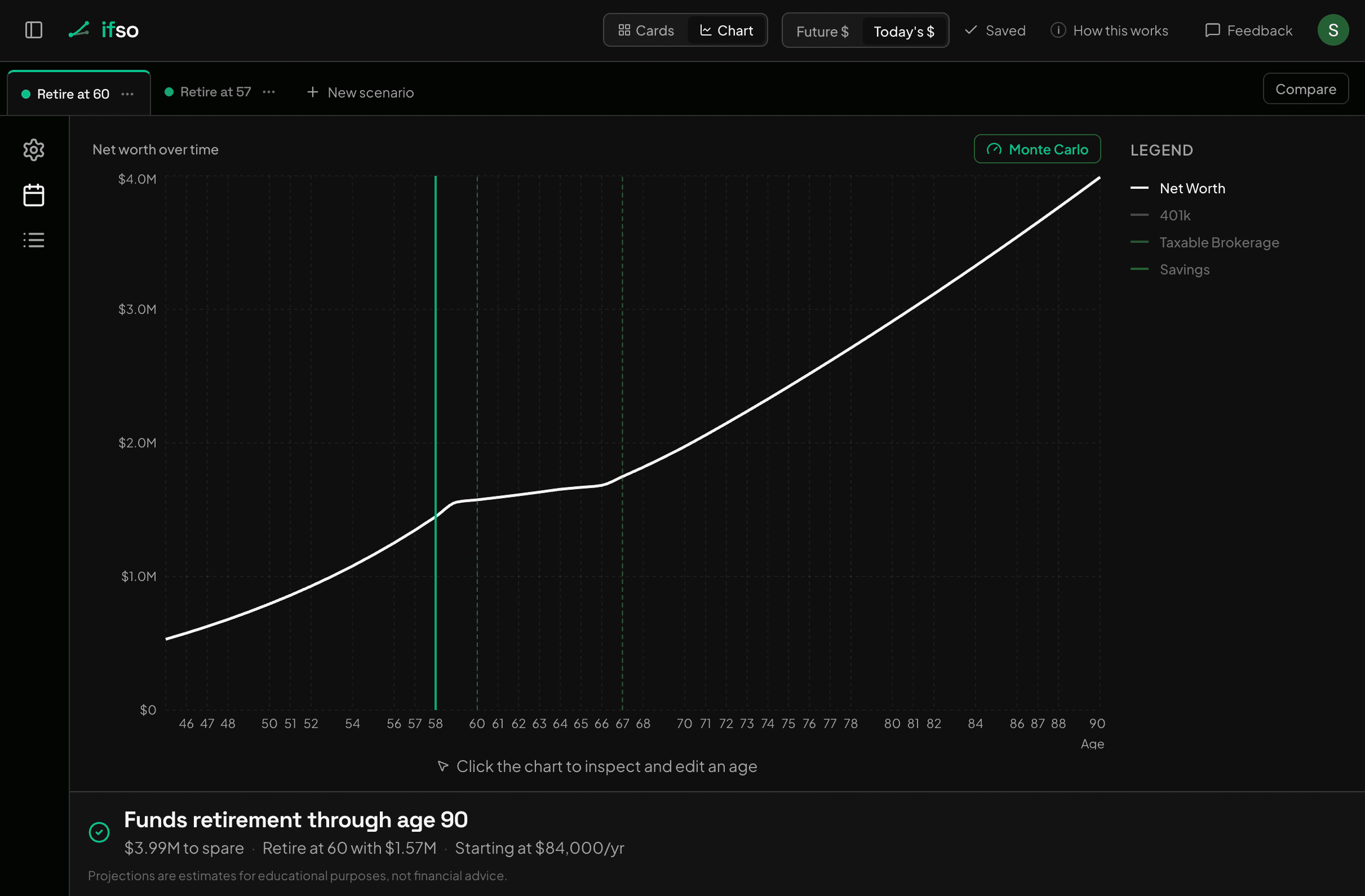
Take Peter, who’s 45. He earns $120,000 and spends about $58,000 a year. He’s got $350,000 in his 401(k), $150,000 in a brokerage account, and $30,000 in savings, and he sets aside roughly $1,800 a month across those accounts. His SSA statement puts his full benefit at 67 at $2,900 a month. His question is the one in the title: can he stop at 60?
In ifso that plan is four inputs: his accounts as they are today, his expenses, a Retire event at 60 with the default 4% draw and access age 65, and a Claim Social Security event at 67 for $2,900. From there the projection plays his sixties out year by year. From 60 to 65 his paychecks are gone and the 401(k) is still locked, so the brokerage account carries everything: those are his bridge years. At 65 the 401(k) opens up and the load shifts there. At 67 Social Security starts and takes a lasting chunk out of the yearly draw.
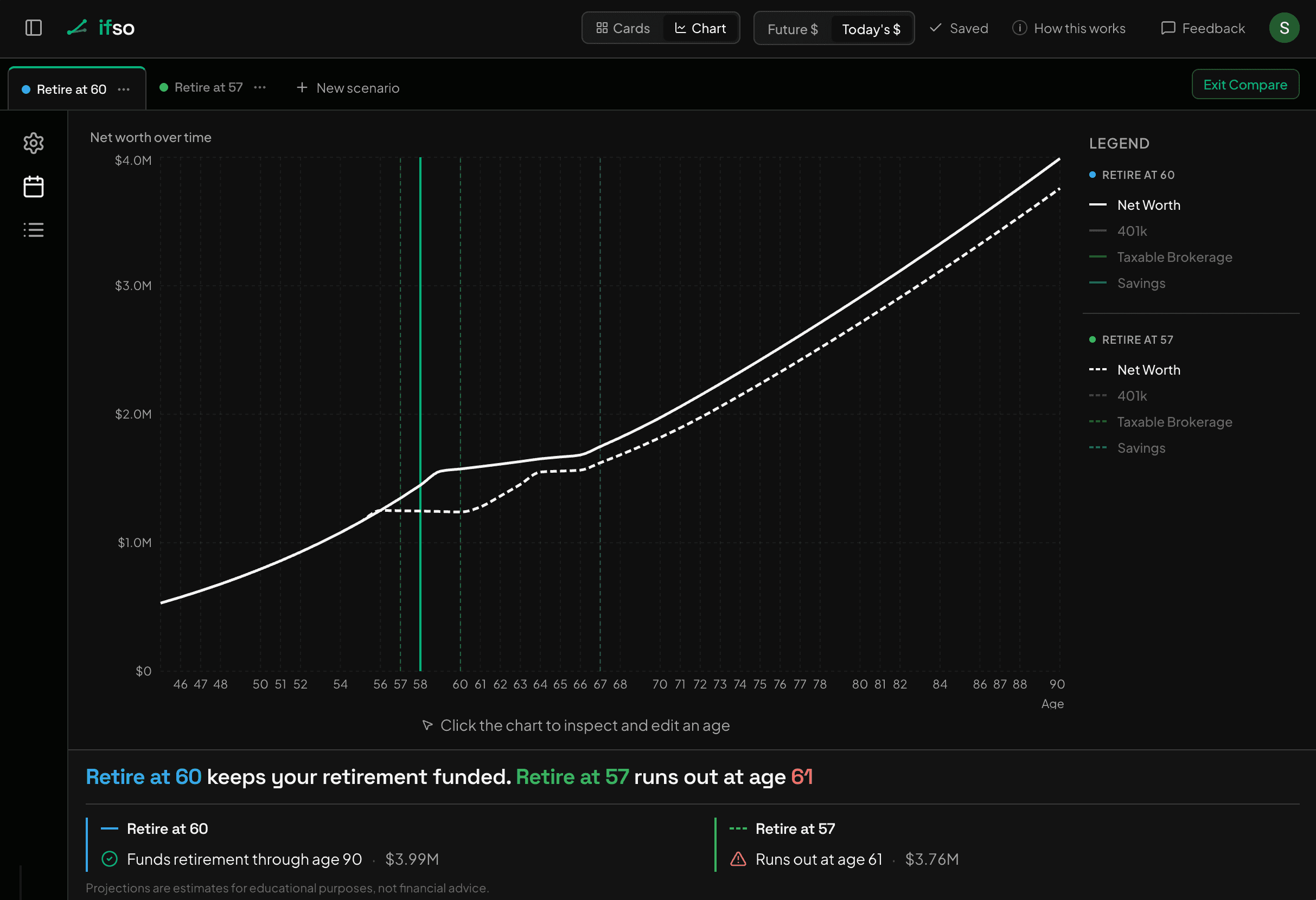
Now for the interesting part: clone the scenario and move retirement to 57. Same savings, same spending, just three fewer years of work. The brokerage now has to cover eight bridge years instead of five, with three fewer years of contributions behind it, and in a plan shaped like this it tends to run dry before the 401(k) ever unlocks. The verdict says as much. Which brings back the point from the first section: his retirement age was never really about how much he’d saved. It was about how much of it he could actually reach at 57.
What moves your retirement age the most
Roughly in order of how much they matter:
- Spending. At a 4% draw, every $1,000 of yearly spending needs about $25,000 of portfolio behind it. Cut $500 a month from your retirement spending and you knock roughly $150,000 off the target. Nothing else here moves the number this much.
- The split between taxable and retirement accounts. If you’re retiring before your access age, the size of the taxable side decides whether the bridge years hold. Saving more doesn’t help if it’s all locked away.
- When you claim Social Security. Waiting from 62 to 70 makes your check 77% bigger, for life. A bigger check means a smaller draw, which means the portfolio has fewer hard years to get through.
- The retirement age itself. Every extra year of work counts three ways: another year of saving, another year of growth, and one less year the portfolio has to fund.
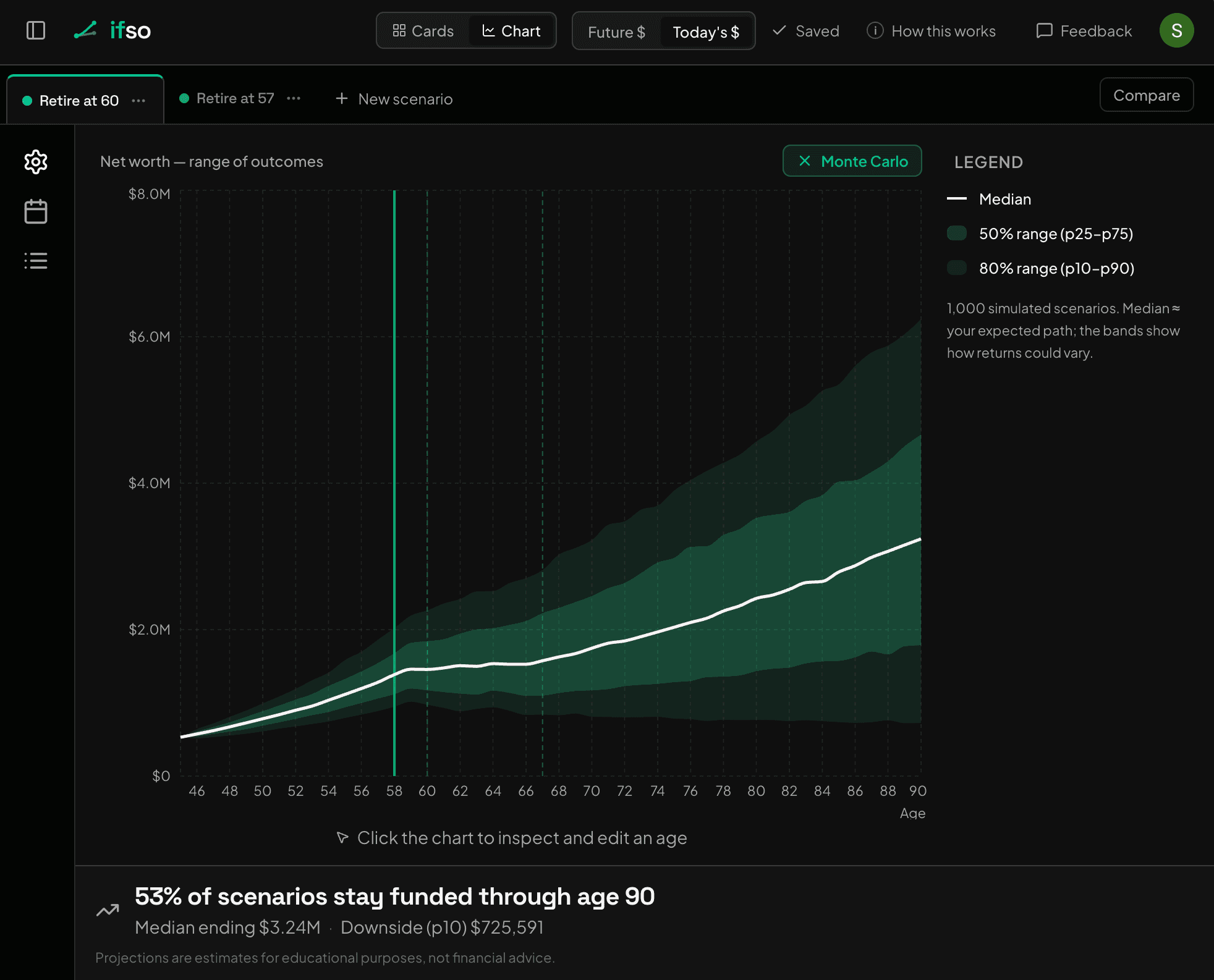
- Returns, which aren’t up to you. A single projection assumes the market behaves like its long-run average. It won’t, and the order the good and bad years come in matters a lot. That’s what Monte Carlo is for: ifso runs your plan against hundreds of possible market paths and reports how often it holds up, as odds instead of one hopeful line.
Model your own retirement
Your own version takes about ten minutes, and none of it needs a linked bank account:
- 1Enter your accounts as they stand today: balances and monthly contributions, keeping the taxable and retirement split as it really is.
- 2Add your actual expenses, so the plan is covering your real life and not a round number.
- 3Add a Retire event at the age you’re hoping for, and set the withdrawal rate and access age if the defaults aren’t yours.
- 4Add a Claim Social Security event using the figure from your SSA statement.
- 5Read the verdict, then nudge the retirement age up or down a year at a time until the plan holds. The age where it flips is your answer, and by now you’ll know which lever got it there.
Now run your own numbers.
Try it free, no sign-upOpens right in your browser with a sample plan ready to edit, with no account needed. No email, no credit card. Create an account only if you want to keep your plan.