Home & housing
Should I rent or buy?
The pragmatic approach to the rent-vs-buy math: amortization, appreciation, and what renting the difference really earns.
Renting gets treated like a mistake you’re supposed to grow out of, money you’ll never see again, while buying is the grown-up thing to do. However, in practice the decision isn't so straightforward. Buying can come out ahead, and so can renting, and which one wins turns on a handful of numbers most of the advice skips right over. Here’s a more robust version of the math, and how to run it on your own life instead of relying on a vague rule of thumb.
Balancing the trade-offs: flexibility vs. forced savings
Strip away the feelings and renting versus buying is a trade between two real things. Renting buys you flexibility: you can leave in a month, your costs are one predictable line, and none of your money is tied up in a single asset in a single city. Buying buys you forced savings: a slice of every mortgage payment quietly turns into equity, and after thirty years the payments stop entirely while a renter’s never do.
The catch is that forced savings isn’t free savings. You pay interest, taxes, insurance, and upkeep for the privilege, and the money you sink into a down payment is money that isn’t growing somewhere else. A renter who takes the difference and actually invests it is running a real strategy, not settling for a worse one. The whole question is which pile of money is bigger at the end, and that’s exactly the kind of thing a projection answers better than instinct does.
What buying actually costs beyond the mortgage
The mortgage payment is the number everyone quotes, and it’s not the cost of owning a home. Owning costs the payment plus a stack of things renting never charges you for.
- Interest, up front and for years. Early in a mortgage almost every dollar is interest, not principal. On a 30-year loan you spend the first decade mostly renting money from the bank, and only slowly start buying the house. ifso calculates the amortization schedule for you, and handles how that schedule accelerates if you add extra principal payments.
- Property tax and insurance. Both ride on the home’s value, not the loan. ifso charges them as a percentage of the place every year, so a pricier home costs more to hold even after it’s paid off.
- Upkeep, which never stops. Roofs, water heaters, the fence, the surprise. A rough rule is about 1% of the home’s value a year over time. Your landlord would eat this cost, but as an owner it’s yours.
- The down payment’s other life. The cash you put down isn’t spent, but it is committed. Whatever it would have earned in the market is a real cost of tying it up in the house, and it’s the one people forget.
The part the rent-vs-buy debate keeps ignoring
The math: amortization, appreciation, and opportunity cost
A fair comparison holds one thing fixed: the money. Same starting cash, same monthly outlay, but two different places to put it. From there ifso runs the two futures side by side, year by year, and three forces do most of the work.
Amortization is the slow trade of payment for equity. Each mortgage payment splits into interest (gone) and principal (kept), and the kept share grows every year as the balance shrinks. ifso builds the real amortization schedule, with interest charged monthly, so the equity you’re accruing is the genuine number and not a straight line. If you choose to add extra principal payments at any time, ifso recalculates the schedule and shows you how much faster you’ll own the house.
Appreciation is the house earning its keep. ifso grows the home’s value at the appreciate rate you set, and because you own the whole house on a fraction of your own cash, that gain lands on the full price. That leverage is the strongest thing buying has going for it, and it cuts both ways if prices stall.
Opportunity cost is what the renter’s money does instead. The down payment that never got spent, plus every month the buyer pays more than the renter, goes into investments growing at your assumed rate. This is the side of the ledger the “renting is throwing money away” line often forgets to account for, and over a long horizon it’s often the biggest number on the page.
Investing the difference within ifso
A worked example in ifso: same money, two futures
Maya is 32, renting a place she likes for $2,200 a month, and sitting on $110,000 she’s saved up. A $450,000 house down the street has her wondering if she’s wasting money by not buying. The fair way to find out is to give both versions of Maya the same $110,000 and the same monthly budget, and see who’s wealthier over a full lifetime.
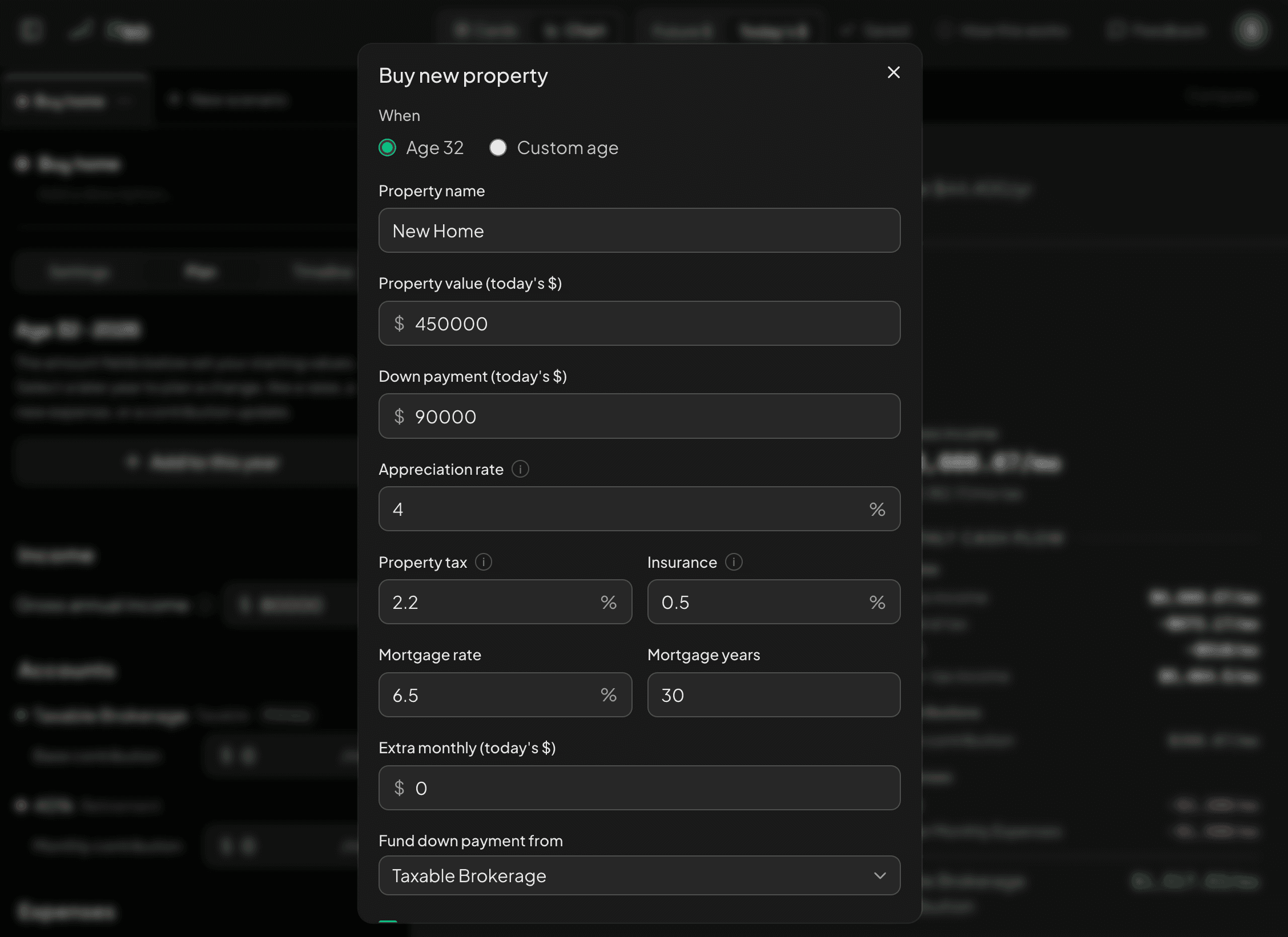
The buy scenario. A Buy event at 32 for the $450,000 home, 20% down ($90,000) pulled from her brokerage, a 30-year mortgage at 6.5%. That leaves a $360,000 loan, about $2,275 a month in principal and interest. On top of it, property tax and insurance run near $1,000 a month combined, and she budgets roughly $375 a month for upkeep. All in, owning costs her about $3,660 a month, and the $20,000 she didn’t put down stays invested.
The rent scenario. Same Maya, same $110,000, but she keeps renting. All $110,000 stays in her brokerage account, and because renting costs her about $1,460 a month less than owning would, she invests that difference too, every month. Nothing here is spent that the buyer didn’t spend. The only difference is where the money lives.
Now the two futures play out. The buyer builds equity two ways, paying down the loan and riding 4% appreciation on the full $450,000, and by retirement she owns a paid-off, more valuable house. The renter never touches a mortgage, but her whole stake plus that $1,460 a month compounds at 10% the entire time. Run it to 75 and the invest-the-difference renter ends up well ahead, about $2.19M more net worth, because a 10% market simply outruns 4% appreciation once the pile is large enough.
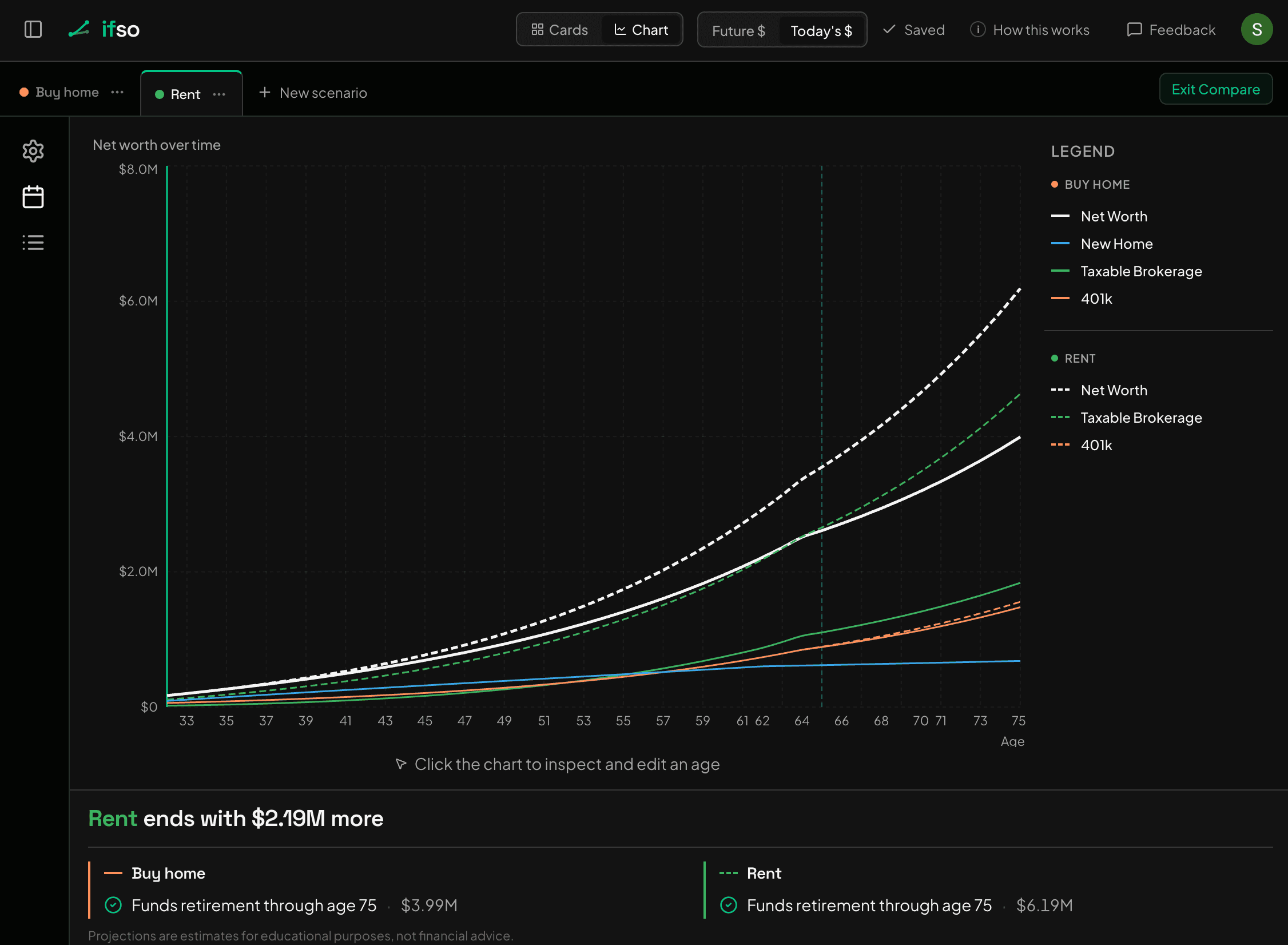
Read that result carefully, because it hides a big “if.” It only holds if Maya actually invests the difference, month after month, for decades. Most people don’t, and this is buying’s quiet superpower: the mortgage forces the saving whether you’re disciplined or not. The house also does something the spreadsheet undervalues, which is stop asking for a bigger check every year while the rent keeps climbing. ifso’s verdict, shown under each scenario in the comparison above, is where it says which pile came out bigger, and it’s worth reading next to that honest caveat.
One footnote in the buyer’s favor: ifso doesn’t subtract the closing costs on the purchase, which typically run a few percent of the price. And one in the renter’s: it doesn’t subtract the realtor’s cut if the buyer ever sells, usually around 6%. Neither changes the shape of the answer, but both are worth remembering when the two lines finish close together.
What changes the answer: time horizon, rates, rent growth
Flipping any of these can also flip the winner. This is why there’s no universal answer, only your answer:
- How long you’ll stay. Buying is front-loaded with costs, the down payment, the interest-heavy early years, the transaction friction. The longer you own, the more time appreciation and principal paydown have to earn it back. Buy for three years and you rarely come out ahead; buy for thirty and the paid-off house changes everything.
- The gap between two rates. The whole contest is home appreciation versus investment returns. Nudge appreciation up or your investment return down in ifso and buying gains ground fast. That single spread moves the verdict more than anything else on this list.
- Rent growth. A mortgage payment is fixed for thirty years; rent isn’t. In the projection your rent rises with inflation, and if you expect it to climb faster than that in your market, raise the number. Fast-rising rent is one of the strongest cases for locking in a payment.
- The price-to-rent ratio. How expensive the house is relative to what renting the same place costs decides a lot before you touch anything else. A cheap-to-buy, expensive-to-rent town tilts hard toward owning; the reverse, where a house costs far more than renting it, tilts toward renting and investing.
- Whether you’ll really invest the difference. On paper the renter invests every spare dollar. In life, the down payment often becomes a car, and the monthly gap becomes lifestyle. If you know that’s you, the mortgage’s forced saving is worth more than the math alone suggests.
Model your own rent vs. buy decision
It takes a few minutes and no linked accounts. The trick is building both scenarios off the same money so the comparison is honest:
- 1Start with your accounts as they are today, including the cash you’d use for a down payment, and add your current rent as an expense.
- 2Add a Buy event at the age you’re weighing, with the home’s price, your down payment, and the mortgage rate and term, funding the down payment from your savings.
- 3Remove the rent from this scenario and add an upkeep expense (around 1% of the home’s value a year). Property tax and insurance are already handled for you.
- 4Clone the scenario, delete the Buy event, and put the rent back. Then add a monthly contribution to your brokerage account equal to the gap between owning and renting, so the renter is investing the difference.
- 5Compare the two and read the verdicts side by side. The gap between them is what the decision is actually worth, and nudging the horizon, the rates, or the rent will show you how solid that answer really is.
Now run your own numbers.
Try it free, no sign-upOpens right in your browser with a sample plan ready to edit, with no account needed. No email, no credit card. Create an account only if you want to keep your plan.