Cars
How much car can I afford? New or used?
Why the monthly payment is the wrong number to shop with, and what depreciation does to the real cost of a car.
A car is one of the biggest things most people buy that ends up losing value. The dealer knows it, which is why they sell you a monthly payment instead of a price, a number that quietly hides the two costs that actually matter: how fast the car sheds value, and what the loan tacks on in interest. Shop by the payment and you’ll drive off in more car than you meant to. Here’s the math the payment hides, and how to run it on your own numbers.
Why the monthly payment is the wrong number to shop with
“$399 a month” sounds like an answer, but it tells you almost nothing. It hides the price, the interest rate, and the length of the loan, and those are exactly the things that decide what the car really costs. Worse, the payment is the one number the dealer can bend at will: stretch the loan to 72 or 84 months and almost any car fits almost any budget, while you quietly pay more interest and spend years owing more than the car is worth.
The numbers worth shopping on are the ones the payment obscures: the drive-off price, the total interest across the whole loan, and how quickly the thing depreciates. Get those right and the monthly payment takes care of itself. Get seduced by the payment and you’ll overpay on all three.
The math: depreciation, interest, and total cost to own
What a car actually costs you is three things stacked together, and only one of them shows up on the loan statement.
- Depreciation, the quiet giant. A car loses value every year whether you look or not, and that lost value is real money, the single biggest cost of ownership for most cars. ifso models the car as a depreciating asset, so you watch its value, and your net worth, step down year by year. Set the rate to match the car: a new one sheds fast, roughly 15% to 20% a year early on; a used one falls more gently.
- Interest, the part you can see. ifso amortizes the loan monthly, so the interest is the real number. A longer term shrinks the payment and swells the total interest, which is the trade the “low monthly” pitch is really asking you to make.
- The costs the sticker skips. Insurance, fuel, maintenance, registration. ifso doesn’t charge these automatically the way it does a home’s property tax, so add them as an expense, because they’re a big slice of the true monthly cost, and a pricier car usually costs more to insure and maintain too.
The dollar the car eats can’t compound
New vs. used in real numbers
The whole case for used fits in one word: depreciation. A new car takes its steepest loss in the first few years, a chunk of it the moment it leaves the lot. Buy the same car two or three years used and someone else has already absorbed that cliff, you get most of the car for a lot less money, and the depreciation from there is gentler.
In ifso you model that by setting a higher depreciation rate on the new car and a lower one on the used, then watching the two net-worth lines. One note on how it works: ifso applies depreciation as a steady annual rate rather than a front-loaded curve, so the brand-new car’s first-year cliff is smoothed into the average. Pick a rate that reflects the whole arc you expect to own it through.
A worked example in ifso
Devin is 28, earns about $75,000, and needs a reliable car. He’s torn between the new SUV he wants and the same SUV a few years used, so he builds both in ifso off the same starting point.
The new-car scenario.A $45,000 SUV, $5,000 down from savings, financed over 72 months at 7%, with depreciation set to about 15% a year to reflect a new car. That’s a $40,000 loan, roughly $680 a month, and a car that’s worth noticeably less than he owes for the first few years.
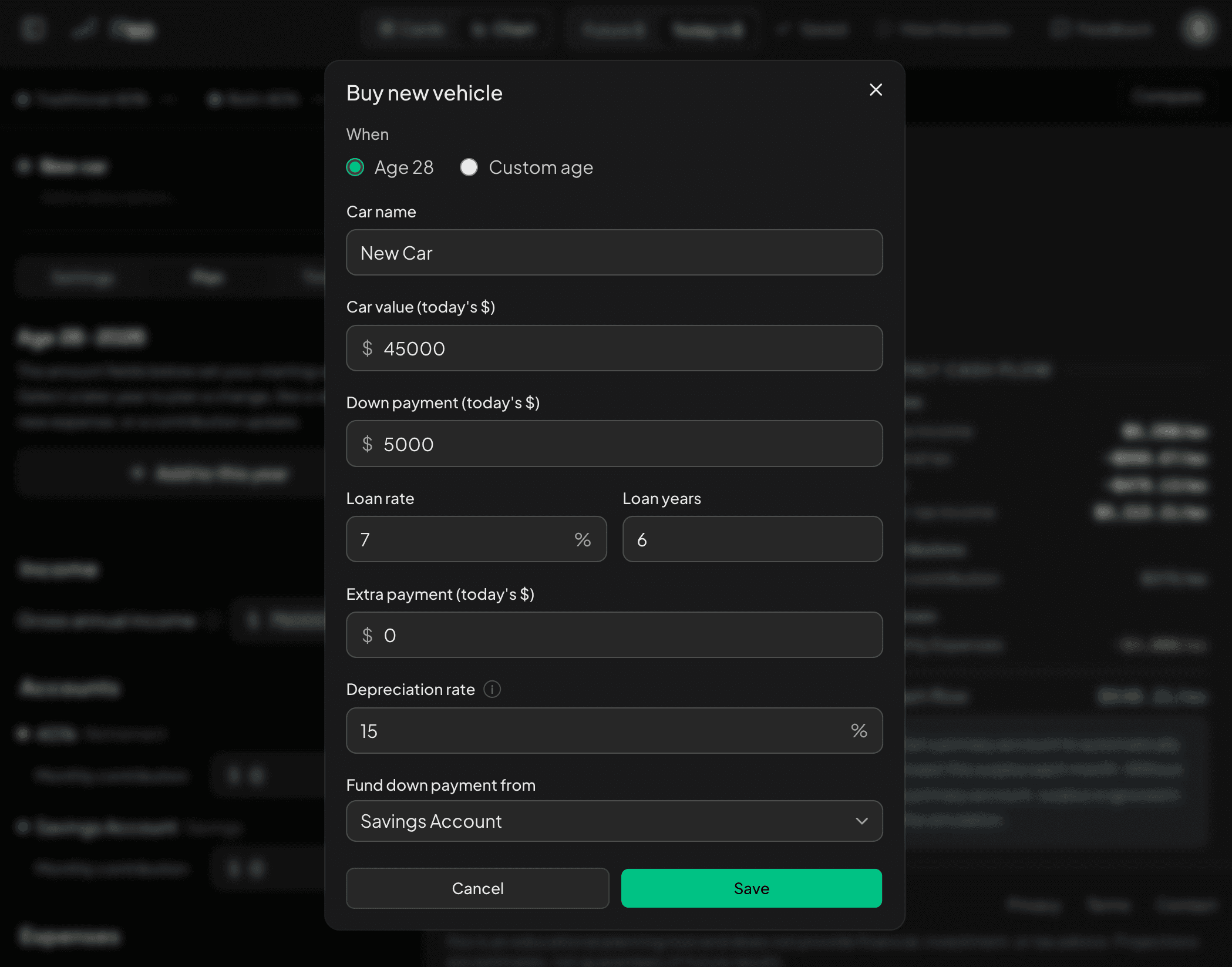
The used-car scenario.Clone it and swap in the same SUV three years old for $28,000, $5,000 down, financed over 60 months at 7.5%, with depreciation set lower, around 10%, since the steepest drop is already behind it. That’s a $23,000 loan and roughly $460 a month.
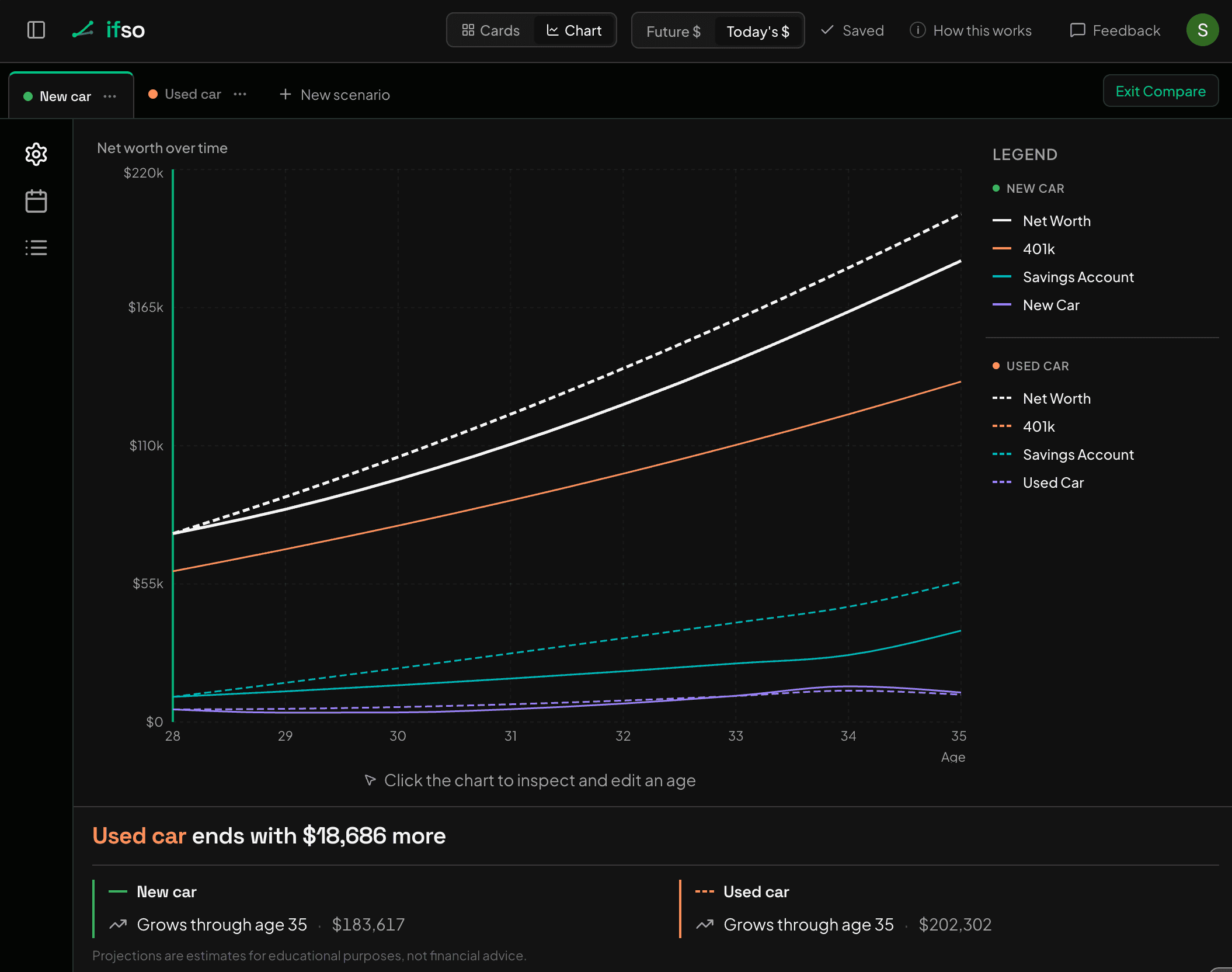
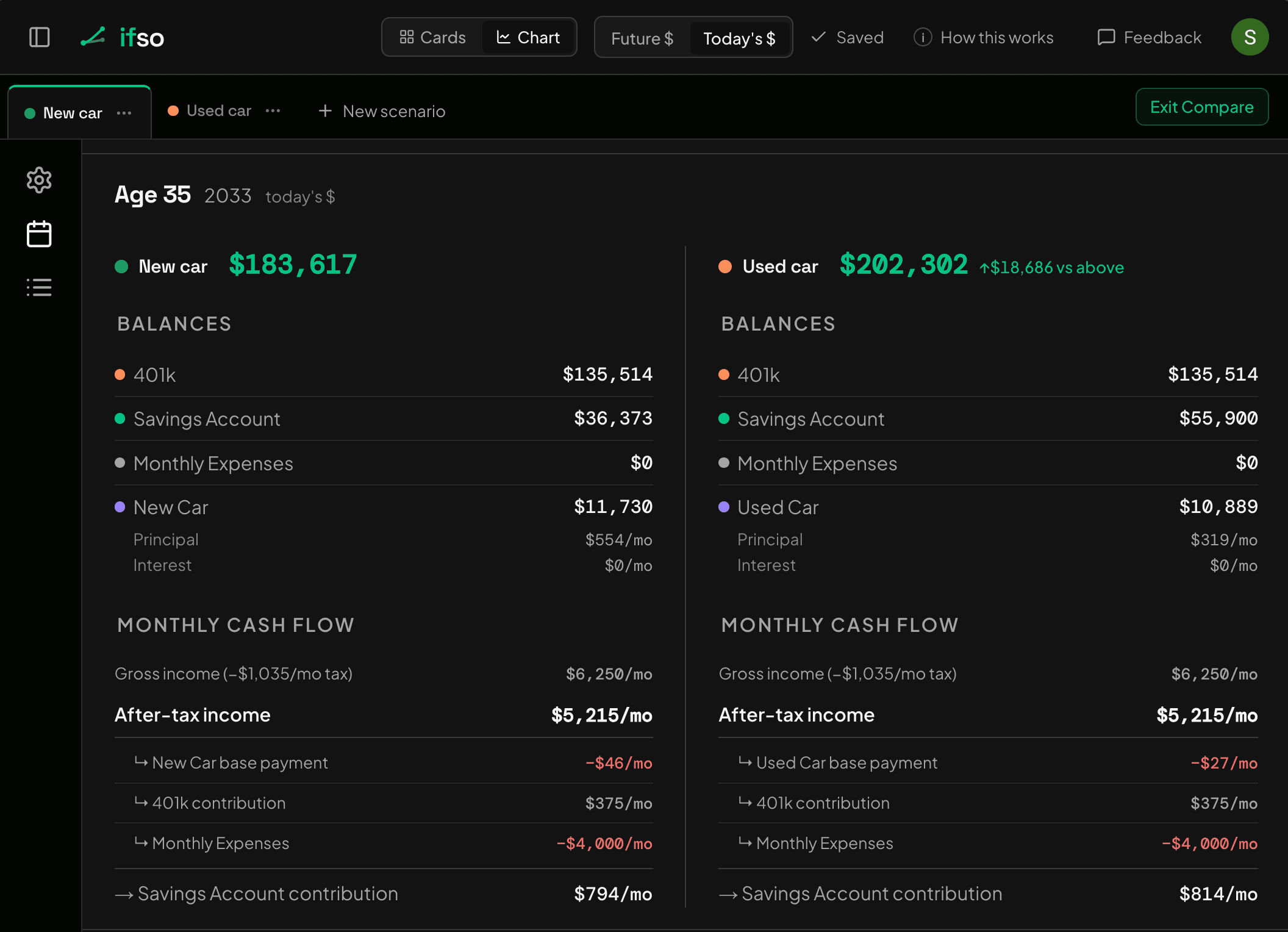
Now the two play out over the next seven years. The new car costs Devin about $17,000 more up front and carries the bigger loan, and with a primary account investing whatever he doesn’t spend on the car, the used-car version of him is ahead by about $18,700 in net worth by 35, $202,300 against $183,600. He gave up nothing he’d actually notice day to day to get there.
Here’s where the money went. By 35 both cars are worth almost the same, around $11,000, because the new one shed roughly $33,000 in value while the used one lost about $17,000. Devin paid far more to end up with a car worth the same, and the money that didn’t vanish into that extra depreciation piled up in savings instead: the used-car Devin sits on about $56,000, the new-car Devin on $36,000. Same paycheck, same life; the only difference is which car he drove off the lot.
Two honest footnotes. Both Devins still pay to insure, fuel, and maintain the car, which you add as an expense, and the new one usually costs more on all three. And because ifso spreads depreciation evenly, the new car’s real first-year drop is a little worse than the smooth line suggests, which only widens the gap in the used car’s favor.
Model your own car purchase
It takes a few minutes and no linked accounts. Build both cars off the same money so the comparison is honest:
- 1Enter your accounts and income as they are today, including the cash you’d put down.
- 2Add a Buy car event at the price you’re considering, with the down payment, the loan rate and term, and a depreciation rate that fits, higher for new, lower for used.
- 3Add the ongoing costs, insurance, fuel, and maintenance, as an expense, since ifso won’t charge them for you.
- 4Set a primary account so the money you don’t spend on the car is invested instead of vanishing into a bigger payment.
- 5Clone the scenario for the cheaper or used car and compare. The gap between the two net-worth lines is what the nicer car actually costs you.
The same trap runs through the biggest purchase of all. If a house is next on your list, how much house can I afford?
Now run your own numbers.
Try it free, no sign-upOpens right in your browser with a sample plan ready to edit, with no account needed. No email, no credit card. Create an account only if you want to keep your plan.