Home & housing
Should I pay off the mortgage early or invest the difference?
A guaranteed return vs. an expected one: how to compare extra payments against investing, with taxes included.
You’ve got some spare money every month and a mortgage you could throw it at. Pay the loan down early and you’re guaranteed to come out ahead by exactly your mortgage rate. Invest it instead and you’ll probably do better, but only probably. So you're left with the following decision: a sure thing against a likely-better thing, with taxes and your own nerves pulling in different directions. Here’s how to weigh it on your own numbers instead of arguing it in the abstract.
The trade-off: guaranteed interest vs. expected growth
Every extra dollar you put toward the principal earns a return, and it’s a strange, quiet kind of return: the interest you now never have to pay. Prepay a dollar on a 6.5% mortgage and you’ve locked in 6.5%, guaranteed, no matter what the market does that year. It’s about the closest thing to a risk-free return an ordinary person can buy.
That same dollar in the market has a higher expected return, historically around 10% in stocks, but the word doing the work is "expected". Some years it’s 25%, some years it’s down 20%, and you don’t get to choose the order they arrive in. So the contest isn’t 6.5% against 10%. It’s a guaranteed 6.5% against a hoped-for 10% that comes with real risk attached, and which one you should want depends on more than the two numbers.
The whole decision fits in one comparison
The math: what an extra payment really earns
Extra payments go straight to principal, and timing is what makes them powerful. Early in a mortgage almost every dollar of a normal payment is interest, so a dollar of principal knocked off now erases all the interest that dollar would have racked up over the remaining years. ifso rebuilds the amortization schedule around your extra payment and shows the payoff arriving years sooner than the contract.
Then something the raw rate comparison misses kicks in. Once the mortgage is gone, the payment goes with it, and that whole monthly sum is suddenly free. Point a "primary account" at it and ifso starts investing it automatically. So paying down early isn’t really investing’s opposite, it’s investing later: you buy the guaranteed return first, and the market return with the freed-up payment after. The competing path is the mirror image, skip the extra payments and invest that money from day one, giving it the maximum time to compound.
In ifso you model the two by setting an "Extra payment" on the mortgage in one scenario, and a monthly contribution to a brokerage account of the same amount in the other. Same dollars, same start date, two different jobs. The projection then plays both out year by year and lets the ending net worth settle the average case.
Taxes complicate both sides
The headline rates aren’t what either side actually keeps. Investment growth gets taxed: a gain in a brokerage account owes capital-gains tax when you sell, and a dollar out of a traditional 401(k) is taxed as ordinary income. ifso applies this for you, so a nominal 10% is really more like 8% or 9% by the time it’s spendable.
The payoff side has no such haircut. The interest you avoid isn’t income, it’s an expense that never happens, so it’s never taxed. Your guaranteed 6.5% is a true, after-tax 6.5%. Line the two up honestly and the gap narrows: a guaranteed 6.5% against an expected, taxed 8-ish percent is a much closer call than 6.5 against 10 made it look.
One honest footnote, and it leans the other way. ifso doesn’t model the mortgage-interest deduction. If you itemize, part of your mortgage interest comes back to you at tax time, which lowers the real rate you earn by paying the loan off and tilts things back toward investing. Since the 2017 standard-deduction jump, most people don’t itemize, so for them the mortgage rate is the genuine return and ifso’s model matches their reality. If you’re one of the few who still itemizes, shade the payoff case down a little in your head.
A worked example in ifso
Marcus is 42 and earns $200,000 a year. He owns a home worth about $520,000 with $360,000 left on a mortgage at 6.5%, a bit over 20 years to go, and a payment near $2,530 a month. He already has $750,000 in his 401(k) and $50,000 in a brokerage account, and he’s found an extra $700 a month he could either throw at the loan or invest. In ifso that’s two scenarios off the same starting point.
The pay-it-down scenario. He adds a $700 Extra payment to the mortgage. ifso rebuilds the schedule, and the loan that had a bit over 20 years left is gone in about 14, clearing around 57 instead of 65. From that point the roughly $2,530 payment and the $700 extra, about $3,200 a month together, are free, and his primary account starts investing all of it for the decades of the run that are left.
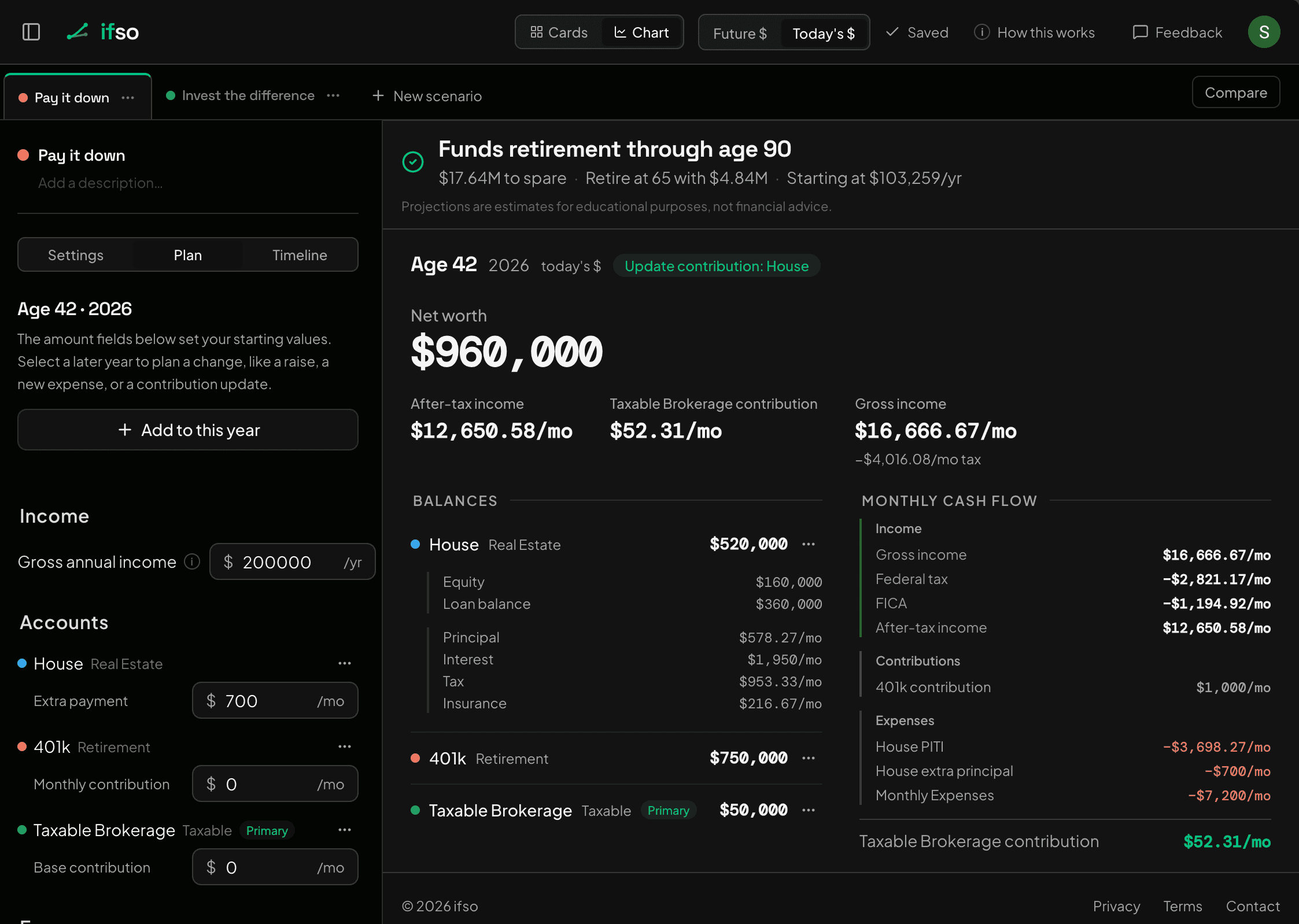
The invest-the-difference scenario. Clone it, drop the extra payment, and instead send $700 a month to his brokerage account, growing at 10%. The mortgage runs its full term while that account compounds the whole way. The gains get taxed when he eventually sells, which ifso handles.
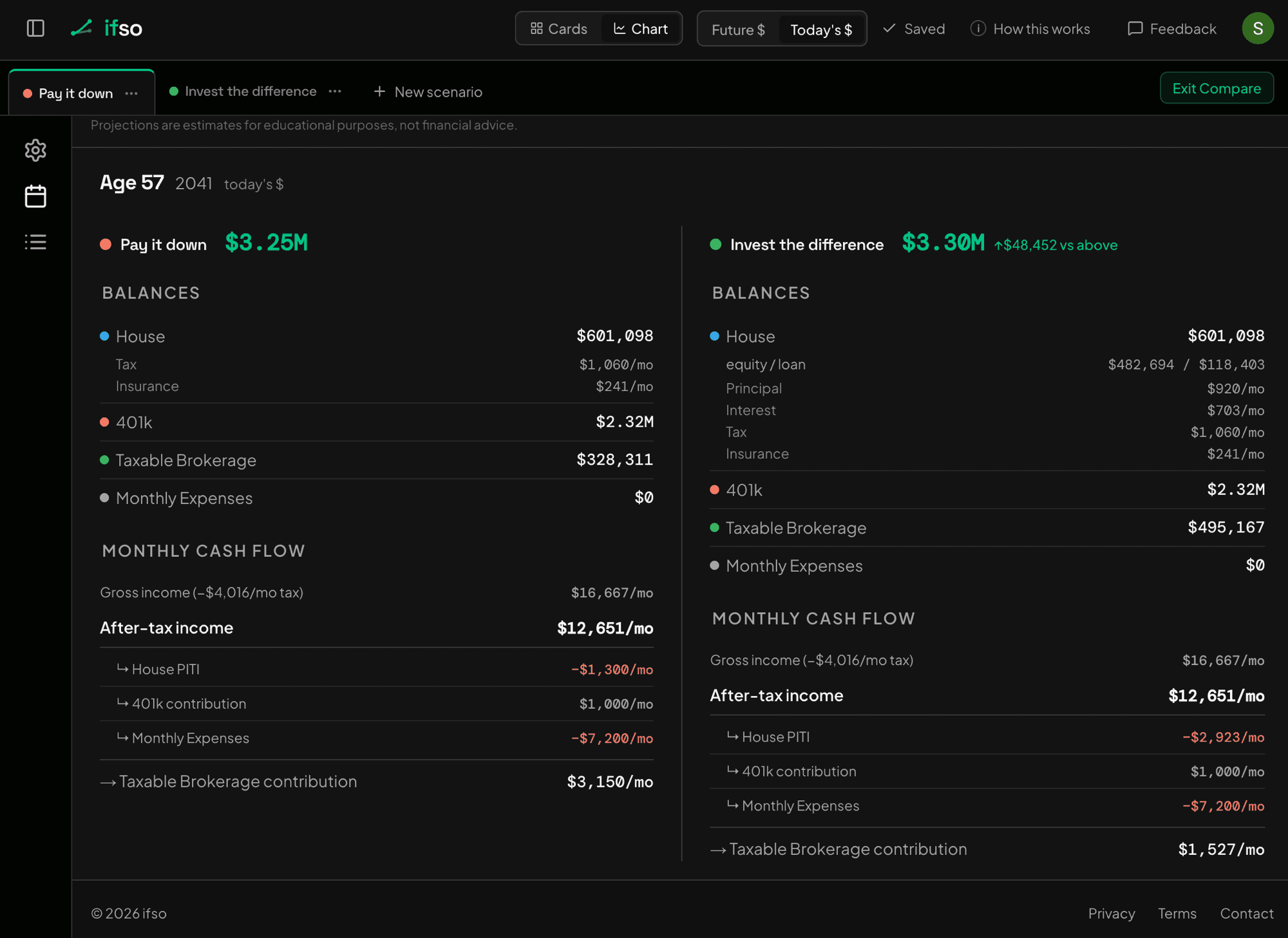
By the time the pay-it-down loan clears at 57, the two futures already have a shape. Marcus is debt-free, the house fully his, but the invest-the-difference version of him has been feeding a brokerage account the whole time and comes out about $48,000 ahead on net worth, roughly $3.30M against $3.25M. The head start he handed the market is already showing.
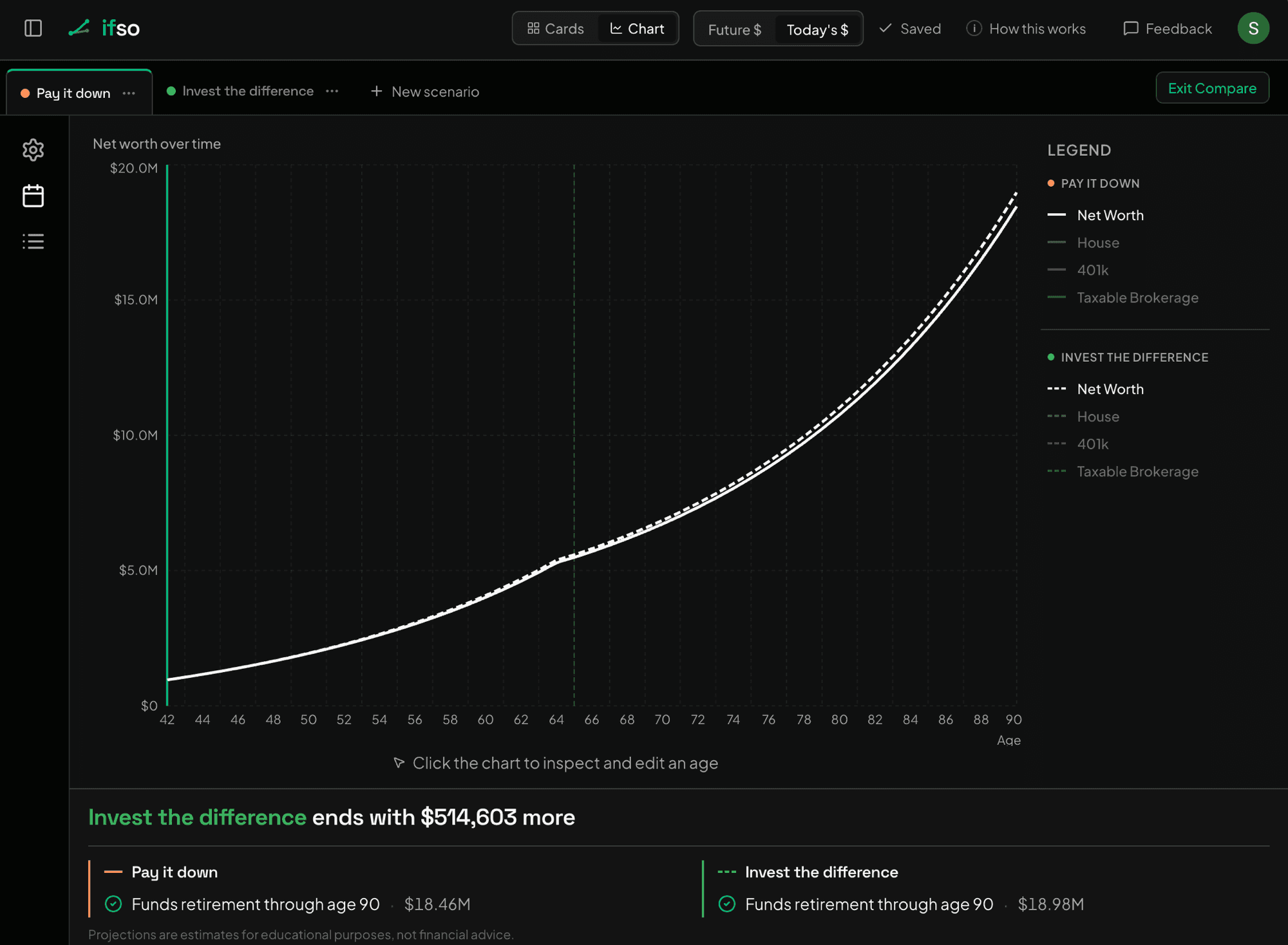
Play both forward to 90 and investing keeps its nose in front the whole way, ending around $18.98M against $18.46M, a lead of about $515,000. That’s the expected-return edge doing its quiet work, even after tax a 10% market outruns a 6.5% loan, but stretched across a portfolio this size it’s a slim margin, not a landslide. On the money alone you’d lean to investing, just not by much.
But a single projection assumes the market returns its long-run average every year, and it won’t. The real worry with leaning on the market is a bad decade landing at the wrong time, so run both scenarios through Monte Carlo, a thousand market paths each, and look at the risk instead of the average. Here’s the surprise: paying the mortgage off barely moves it. Both plans stay funded in 89% of the paths, no better and no worse, so the same roughly one-in-nine chance of running short by 90 hangs over each. They even share the exact rough-market floor, a 10th-percentile ending near $827,000, and the median leans a hair toward investing. The certainty you’d expect to buy by going debt-free never really shows up for Marcus, because a $700 a month swing is a rounding error against a $200,000 income and a portfolio already in the millions.
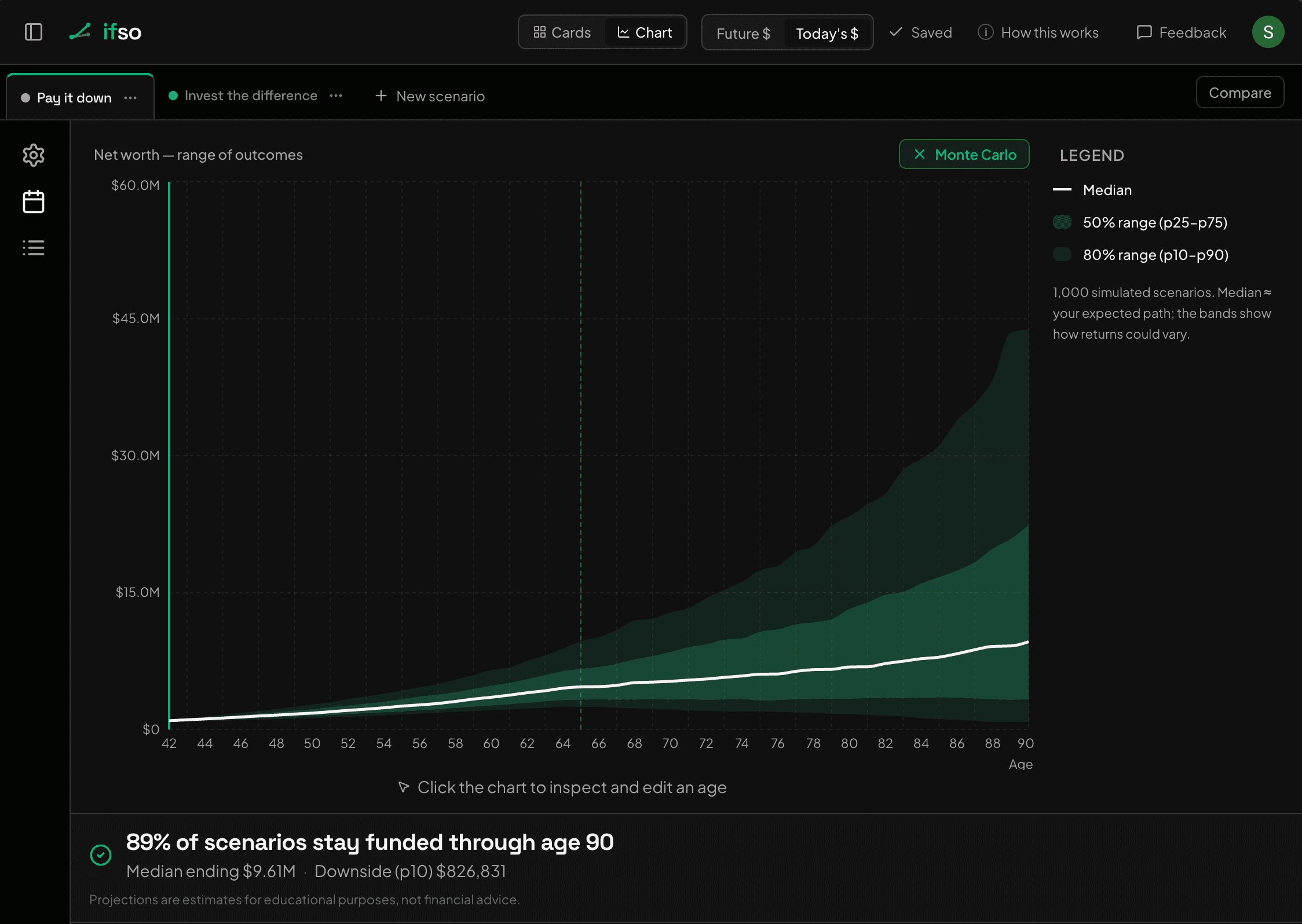
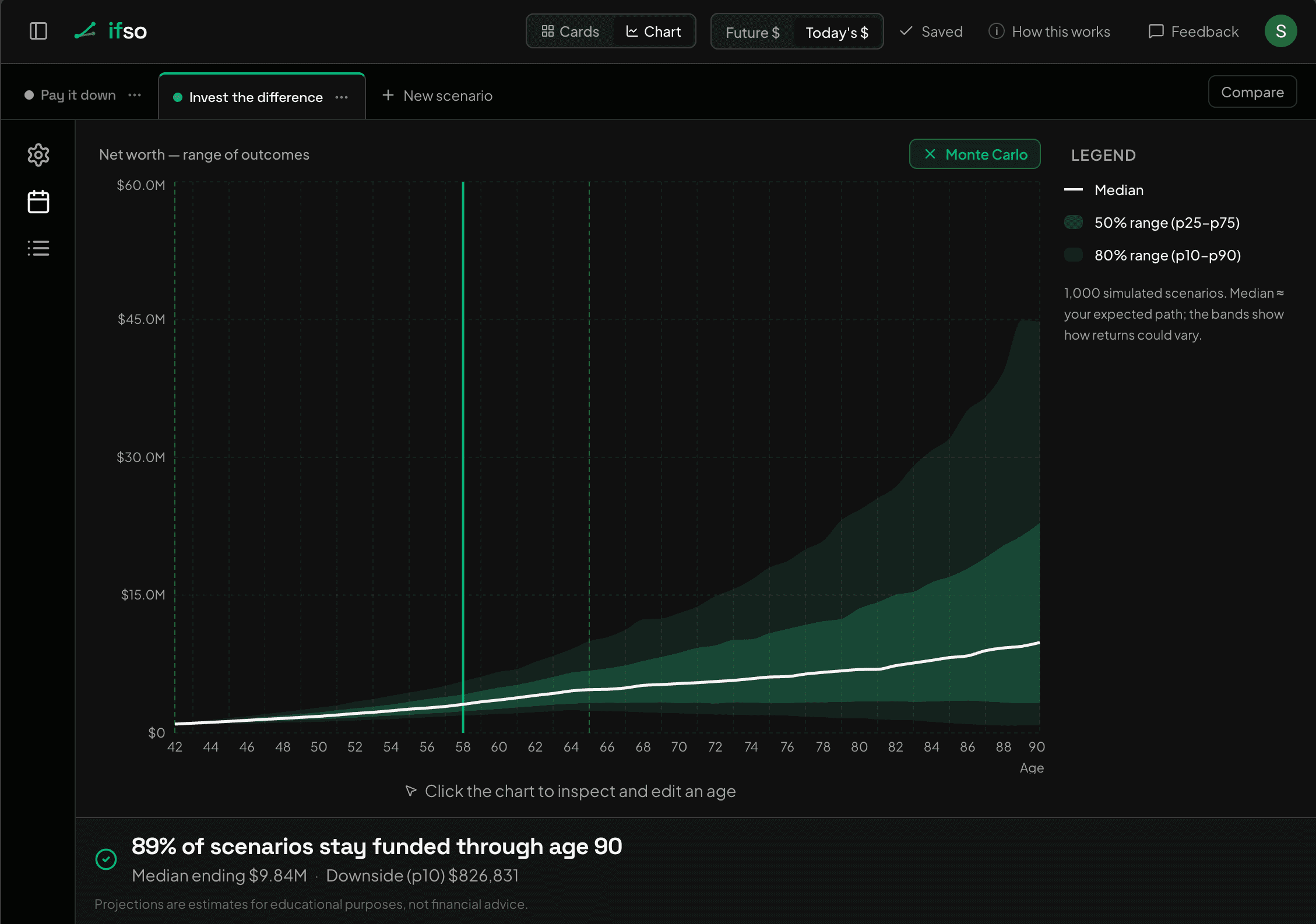
So for Marcus the honest read is that it barely matters. Investing edges ahead on the money and ties on safety, so whichever he picks, his retirement lands in about the same place. It won’t be true for everyone, though. The whole reason payoff can win is certainty, and certainty counts for most when the payment is a big share of your budget, when your rate is high, or when you’re close enough to retirement that one bad year lands hard. Which is exactly what the next section is about.
What changes the answer: your rate, your horizon, your nerves
Move any of these and the balance shifts, sometimes decisively:
- Your mortgage rate. This is the hurdle the market has to clear, and it decides almost everything. A 3% pandemic-era mortgage is nearly never worth prepaying, because any diversified portfolio should beat 3% comfortably. A 7.5% mortgage is a genuinely close call, and the higher it climbs, the more paying it down wins outright.
- Your time horizon. The longer until you’d touch the money, the more room the market has to deliver its edge and recover from a bad stretch, which favors investing. A short horizon, or money you’ll need soon, favors the guaranteed return that can’t have a bad year.
- Your nerves, and where you are in life. A guaranteed 6.5% is something you’ll never regret. A hoped-for 10% that turns into a 20% drawdown the year you retire is something you might. Sequence-of-returns risk near retirement, and plain peace of mind, both tilt toward payoff even when the average math leans the other way.
- A smaller bill in retirement. Clearing the mortgage before you stop working lowers your cost of living for good, so the savings you need to retire are smaller and your monthly withdrawals lean on the market less. In dollars the extra invested balance usually makes up for it, which is why Marcus’s odds came out the same either way. But needing less every month, for the rest of your life, is a real kind of security a net worth number never captures, and for a lot of people it’s the whole reason to go into retirement debt-free.
- Whether you’ll actually invest it. The extra payment is automatic once you set it. Investing the difference only builds wealth if you truly do it, every month, and don’t quietly let it become spending. If you know yourself, weight that honestly.
- Liquidity. Money you send into the mortgage is locked in the house, hard to get back without a refinance, a HELOC, or a sale. Money in a brokerage account stays reachable for an emergency or an opportunity. Prepaying buys a guaranteed return by giving up flexibility.
Model your own payoff plan
It takes a few minutes and no linked accounts. The trick, as always, is building both scenarios off the same spare dollars so the comparison is fair:
- 1Add your home with its current value, mortgage balance, rate, and the years you have left, along with the rest of your accounts and expenses.
- 2In the first scenario, set an Extra payment on the mortgage equal to your spare cash, and watch the payoff date move years earlier.
- 3Set a primary account so the freed-up payment invests itself automatically once the mortgage is gone.
- 4Clone the scenario, remove the extra payment, and instead add a monthly contribution of the same amount to your brokerage account.
- 5Compare the verdicts, then run both through Monte Carlo. The single projection tells you which ends bigger on average; the odds tell you which one sleeps better.
If the real question underneath this is whether you’ll reach retirement at all, and paying the house off early is part of how, start there: when can I actually retire?
Now run your own numbers.
Try it free, no sign-upOpens right in your browser with a sample plan ready to edit, with no account needed. No email, no credit card. Create an account only if you want to keep your plan.