Retirement
Should I sell the house when I retire?
What downsizing actually frees up once you count the equity out, the new costs in, and the taxes in between.
Downsizing gets pitched as an easy win: sell the big house, buy something smaller, pocket the difference. The catch is that the difference is smaller than the price gap makes it look. Selling costs money, buying costs money, and the gain on a home you’ve owned for years can be taxed. This is the honest version of the math, and how to run it on your own numbers.
What selling the house actually frees up
The distance between what your home is worth and what your next place costs isn’t what ends up in your pocket. Three things sit in between.
- The mortgage, if you still have one. You pay off the remaining balance out of the sale first. Only the equity, what’s left after the loan, is yours to move.
- The tax on the gain.Selling an appreciated home is a taxable event. If it’s your primary residence a large chunk of the gain is shielded, but a home you bought cheap a long time ago can have a gain that runs past the shield.
- The next place. Whatever you spend on the smaller home, or the deposit and moving costs if you rent, comes straight back out of the cash you just freed.
What’s left after those three is what downsizing actually adds to your savings. It’s usually a real number, just not the headline one.
The math: equity out, new costs in
Downsizing has two sides: a one-time lump of cash from the sale, and the ongoing costs that change afterward.
Equity out. The cash from selling is the sale price minus any remaining mortgage. ifso deposits that into whichever account you point it at, so you can watch it join your investments.
The gain, and the exclusion.Your capital gain is the sale price minus what you originally paid, your cost basis, not minus the mortgage. If the home is your primary residence, the first $250,000 of that gain ($500,000 if you’re married filing jointly) is excluded from tax, and anything above it is taxed as a long-term capital gain. ifso runs this for you and takes the tax out of the proceeds, so the number that lands in your account is already after tax.
New costs in.A cheaper home is cheaper to hold. ifso charges property tax and insurance as a percentage of each home’s value, so a smaller place costs proportionally less every year, and you can bring your upkeep down to match. A condo might add an HOA fee, which you’d enter as an expense.
A worked example in ifso: downsizing at 68
Dave and Karen are both 68 and retired. They raised their kids in a four-bedroom house that’s bigger than the two of them need now, worth about $750,000, bought decades ago for $150,000 and long since paid off. They’re living off a portfolio that’s starting to feel thin, and they want to know what selling the house would really do for them.
In ifso, their plan is three pieces: their home, entered with its $750,000 value, its $150,000 original purchase price, and marked as their primary residence; a Sell event at 68 that sends the proceeds to their brokerage account; and a Buy event at 68 for a $400,000 townhouse, paid in cash.
The sale plays out like this. Their gain is $750,000 minus the $150,000 they paid, or $600,000. As a married couple selling their primary residence, the first $500,000 is excluded, which leaves $100,000 taxed as a long-term capital gain, something like $15,000 at their rate. They keep about $735,000 of the $750,000. The townhouse takes $400,000, so about $335,000 joins their investments.
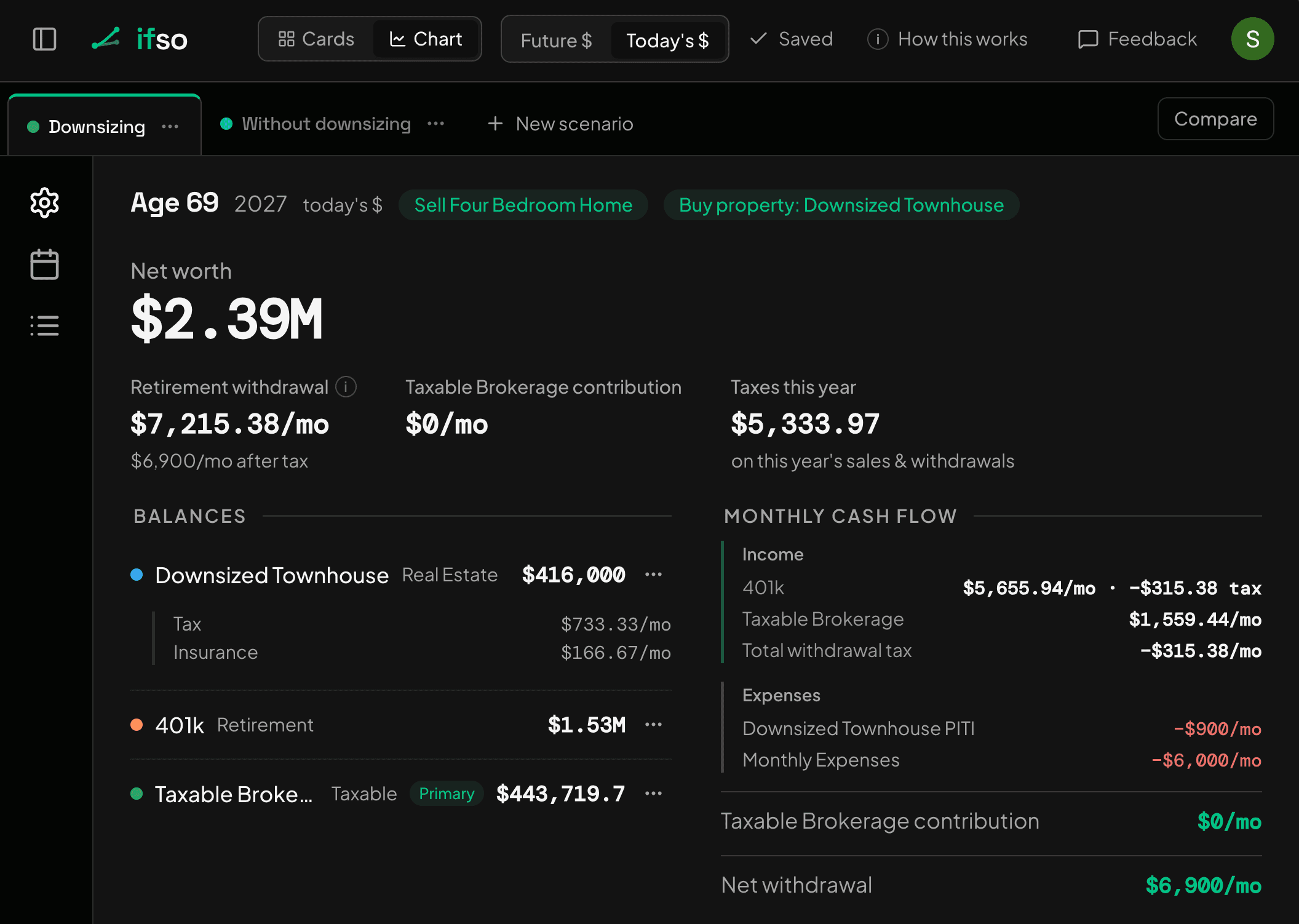
Their costs fall at the same time. Because property tax and insurance ride on the home’s value, the $400,000 townhouse costs a little over half what the $750,000 house did to hold, freeing several thousand dollars a year on top of the lump sum.
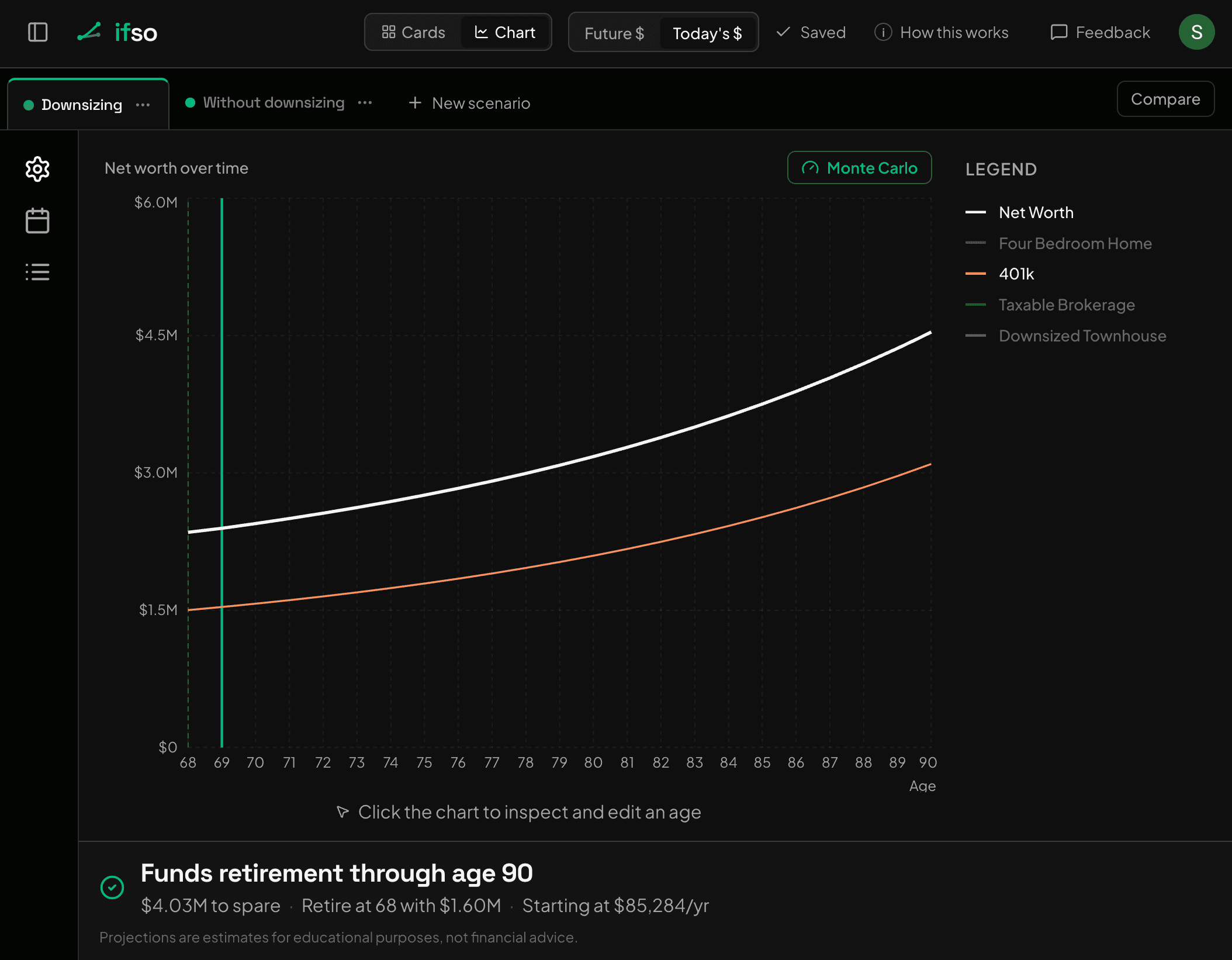
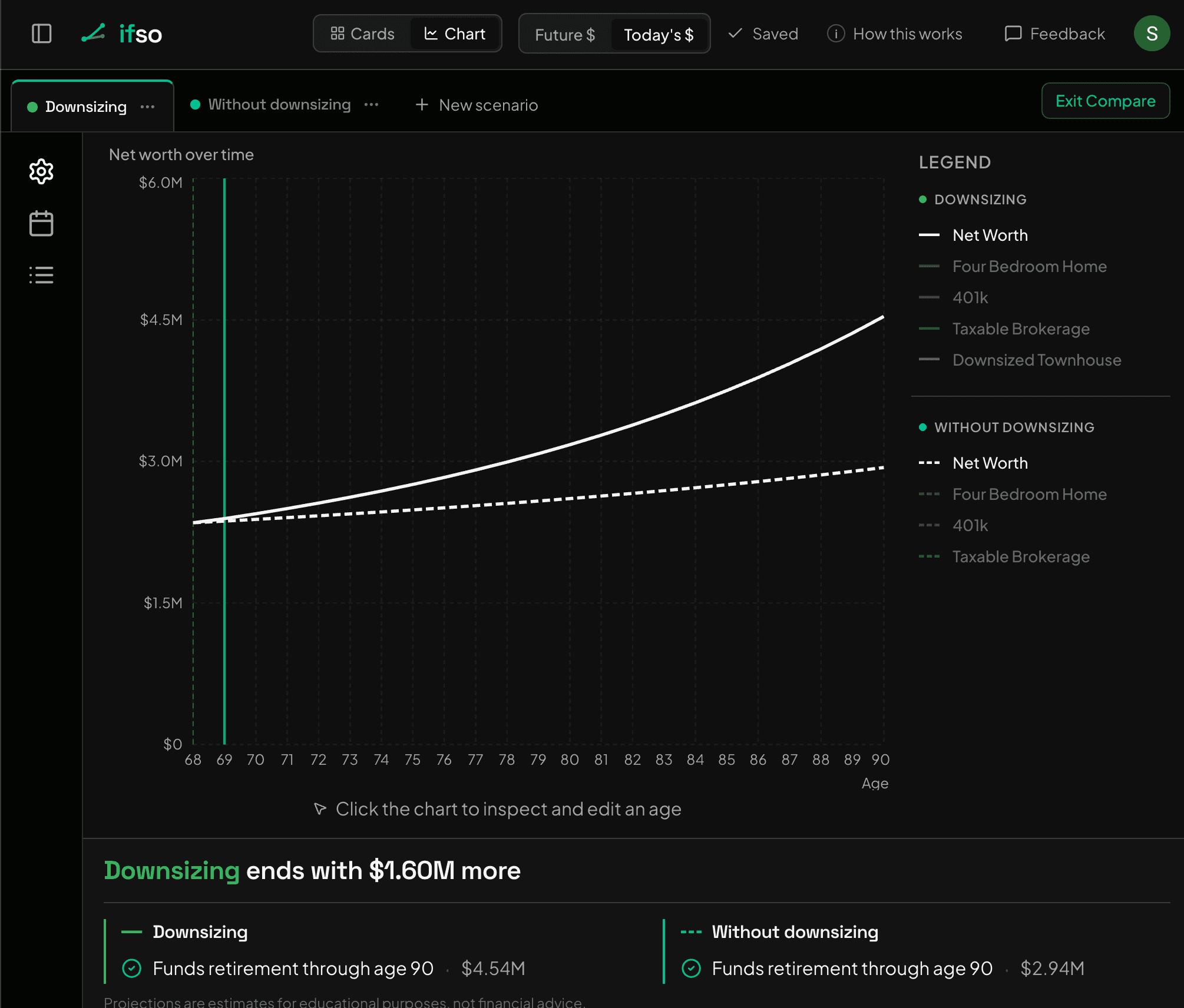
Then the comparison that matters: clone the scenario and leave the house alone. Staying put, their portfolio thins out earlier. Downsized, they have the extra $335,000 working for them and a lower cost of living, and the plan holds years longer. The gap between the two verdicts is what the move is worth.
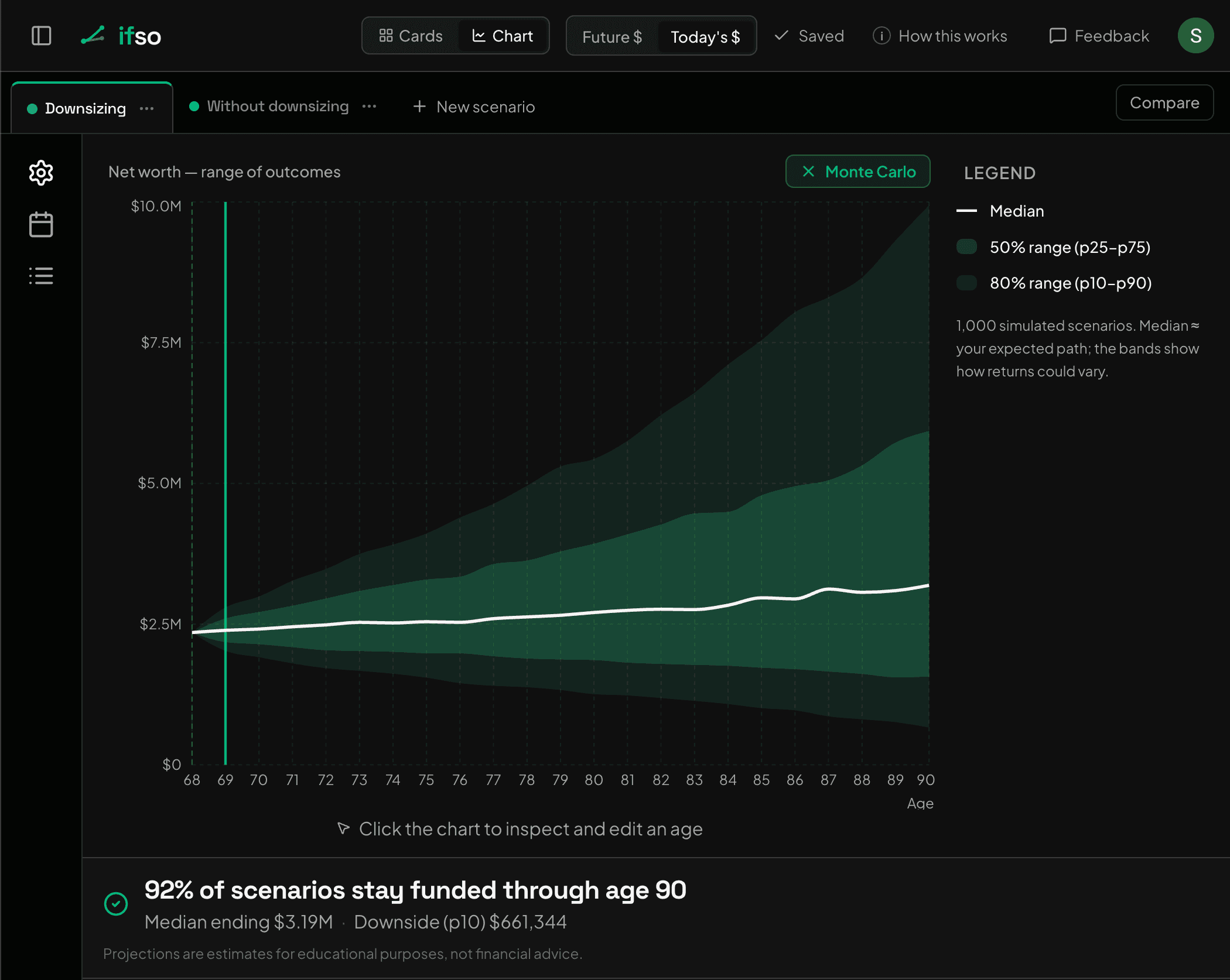
That comparison is a single projection, which assumes the market returns its average every year. Running both scenarios through Monte Carlo, hundreds of simulated market paths, sharpens the case. Downsized, Dave and Karen’s plan stays funded through age 90 in 92% of scenarios. Staying put, that drops to 73%. The freed-up equity and the lower cost of living don’t just move the average outcome, they give the plan more room to absorb a bad stretch of returns.
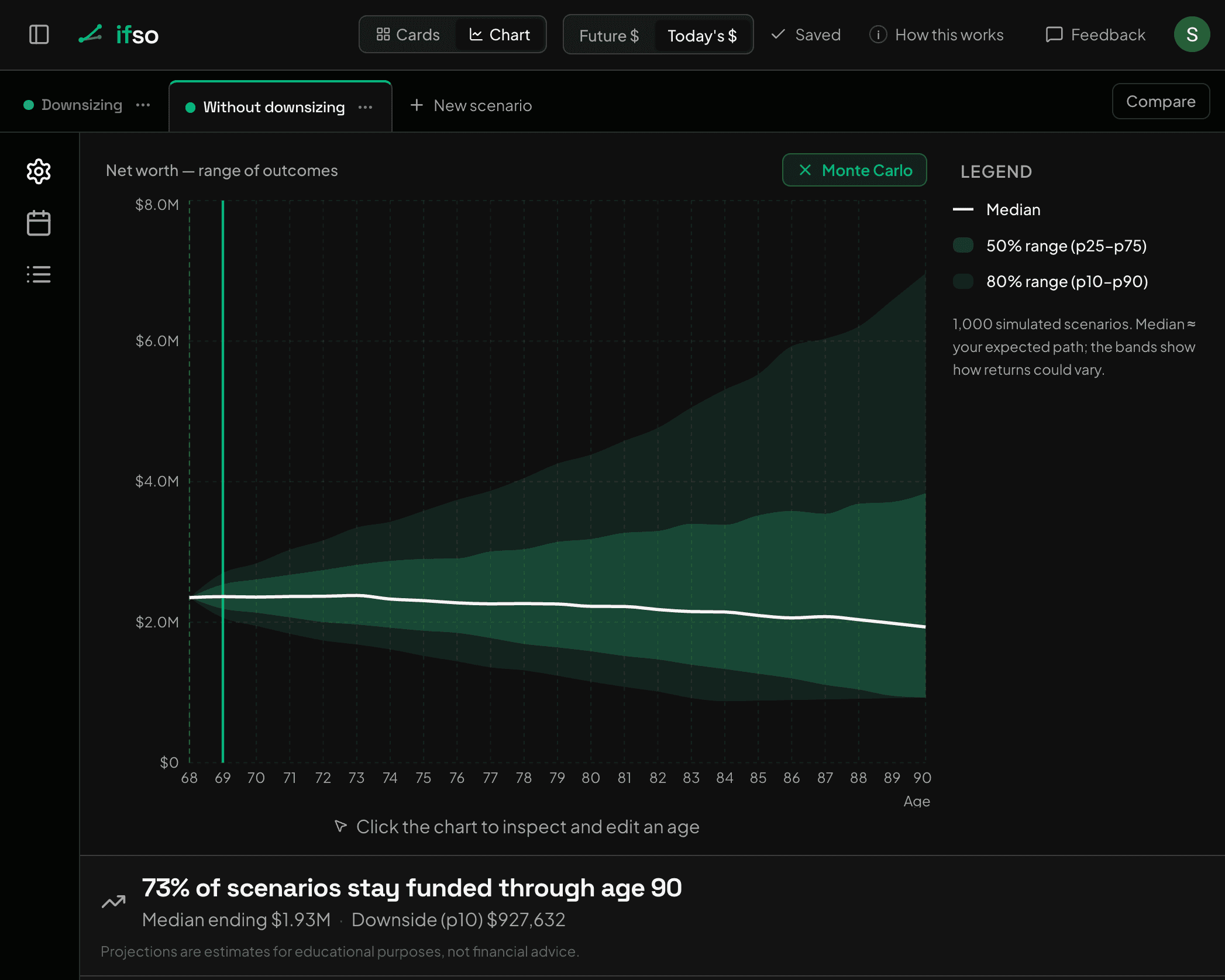
One honest footnote: that $335,000 is before the selling costs ifso doesn’t subtract. At around 6% of the sale, figure closer to $290,000 actually in their pocket.
Often the deeper question underneath downsizing is just whether retirement works at all. If that’s where you are, it’s worth starting there: when can I actually retire?
What changes the answer: market, timing, the next home
A few things move the downsizing math more than the rest:
- How much you spend on the next place. The gap between the two prices is the whole point. Trade a $650,000 house for a $600,000 one and you free up almost nothing. The smaller the next home, the bigger the payoff.
- Your cost basis and how long you’ve owned. A home bought cheap decades ago carries a large gain, and past the exclusion that’s real tax. A place you bought recently has little gain and usually owes nothing.
- Single or married. The exclusion is $250,000 single, $500,000 married filing jointly. A surviving spouse selling alone has half the shield, which can turn a tax-free sale into a taxed one.
- The ongoing savings, not just the cash. Lower property tax, insurance, and upkeep add up year after year. Over a long retirement they can matter as much as the one-time lump.
- Renting instead of buying. Sell and rent and you free up the entire equity, since nothing goes into a next home, but you take on rent as a new expense. ifso will show you whether that trade comes out ahead.
Model your own downsize
- 1Add your current home with its value and its original purchase price, and mark it your primary residence so the exclusion is applied.
- 2Add a Sell event at the age you’re weighing, sending the proceeds to your investment account.
- 3Add a Buy event for the smaller place, or skip it and add rent as an expense if you plan to rent instead.
- 4Lower your housing expenses to match the smaller home, and add an HOA fee if the new place has one.
- 5Clone the scenario without the move and compare the two. The difference between the verdicts is what downsizing is actually worth to you.
Now run your own numbers.
Try it free, no sign-upOpens right in your browser with a sample plan ready to edit, with no account needed. No email, no credit card. Create an account only if you want to keep your plan.