Saving & investing
Roth or traditional: which should I fund?
The one question that decides Roth vs. traditional, and what the same dollars look like under each by retirement.
Roth or traditional often gets overcomplicated, when it’s really just one question with a number behind it: is your tax rate higher now, or in retirement? Both accounts shelter the same dollars and grow them the same way. The only difference is when the tax gets paid, and which one wins is simply whichever rate is lower. Here’s how to find your answer instead of guessing at it.
The one question that decides it: your rate now vs. later
Strip away the jargon and the two accounts are mirror images. A traditional contribution is deducted from your income this year, so you pay no tax on it now, and then every dollar you withdraw in retirement is taxed as ordinary income. A Roth contribution is the reverse: no break today, you pay tax on that income first, but the account is then yours for good, growth and withdrawals never taxed again.
So the whole decision reduces to a single comparison: pay tax at today’s rate, or at your retirement rate. If you’re in a high bracket now and expect a lower one once the paychecks stop, traditional wins, you skip the tax at a high rate and pay it back at a low one. If you’re early in your career in a low bracket now and expect to earn more later, Roth wins, you lock in today’s low rate and walk away from the higher one. That’s the entire game.
Why a flat rate makes them identical
The math: same dollars, different tax timing
ifso models both sides of the timing honestly. Fund a traditional account and it lowers your taxable income for the year, so you watch this year’s tax bill drop; then in retirement it taxes each withdrawal as ordinary income at whatever bracket you land in. Fund a Roth and this year’s tax is untouched, but the account comes out clean on the other end.
There’s one trap worth naming. A traditional balance always looks bigger, because part of it still belongs to the IRS. A Roth balance is smaller but entirely yours. Comparing the two headline numbers flatters traditional every time. The honest comparison is what you can actually spend, and ifso handles it by grossing up each traditional withdrawal for the tax it owes, so the after-tax lifestyle is what you’re really comparing, not the raw balance.
There’s a second assumption hiding in the rule, and it’s the one people miss: a traditional break is only real money if you invest it. The lower tax bill hands you extra take-home today, and the whole case for traditional assumes that money goes to work instead of getting spent. In ifso that means routing your surplus to a primary account; leave it unset and the extra take-home is treated as spent, which is honestly how most people handle a smaller tax bill. Skip that step and traditional quietly forfeits its edge, because you keep the taxed withdrawal without ever banking the deduction. Watch for it in the example below.
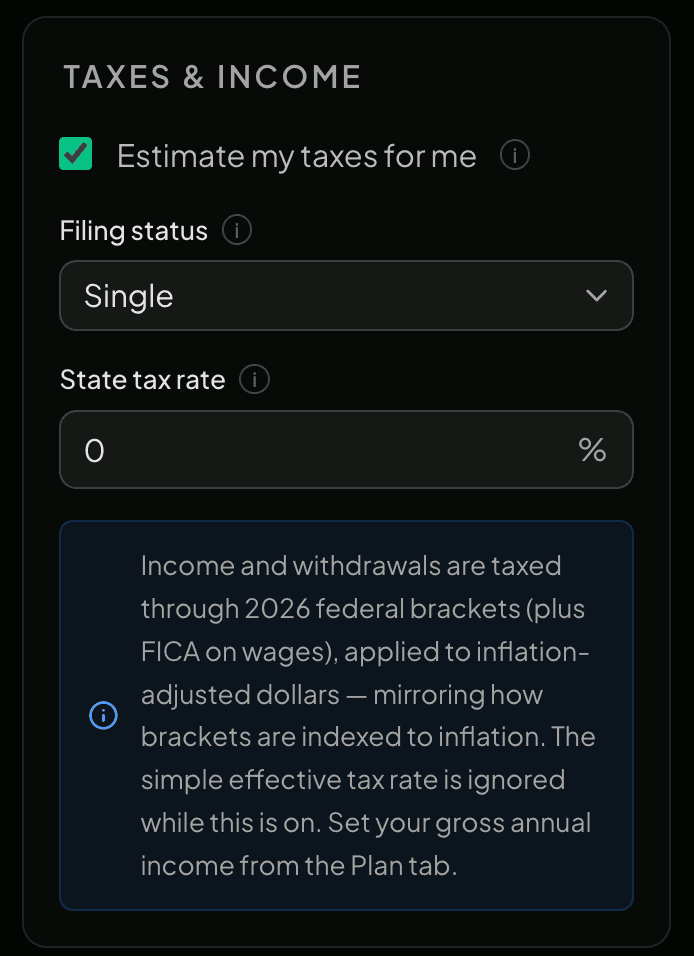
Turn on advanced tax mode for this one
Where the ladder fits: get the match first
Before you spend a minute on Roth versus traditional, there’s one move that outranks the whole debate: the employer match. If your 401(k) matches contributions, put in at least enough to collect all of it. A 50% or 100% match is an instant, guaranteed return no tax strategy can come close to, and ifso counts the match for you. Roth versus traditional is a separate question, how your own contributions get taxed, that you settle once the match is locked in.
One more wrinkle at the top end. If you’re maxing the annual limit, Roth quietly fits more real wealth inside the shelter, because the limit is a dollar figure. The full limit in a Roth is that much tax-free money; the same limit in a traditional account still owes tax later, so effectively less of it is yours. For a strong saver bumping the cap, that tips the scales toward Roth even before you look at rates.
A worked example in ifso
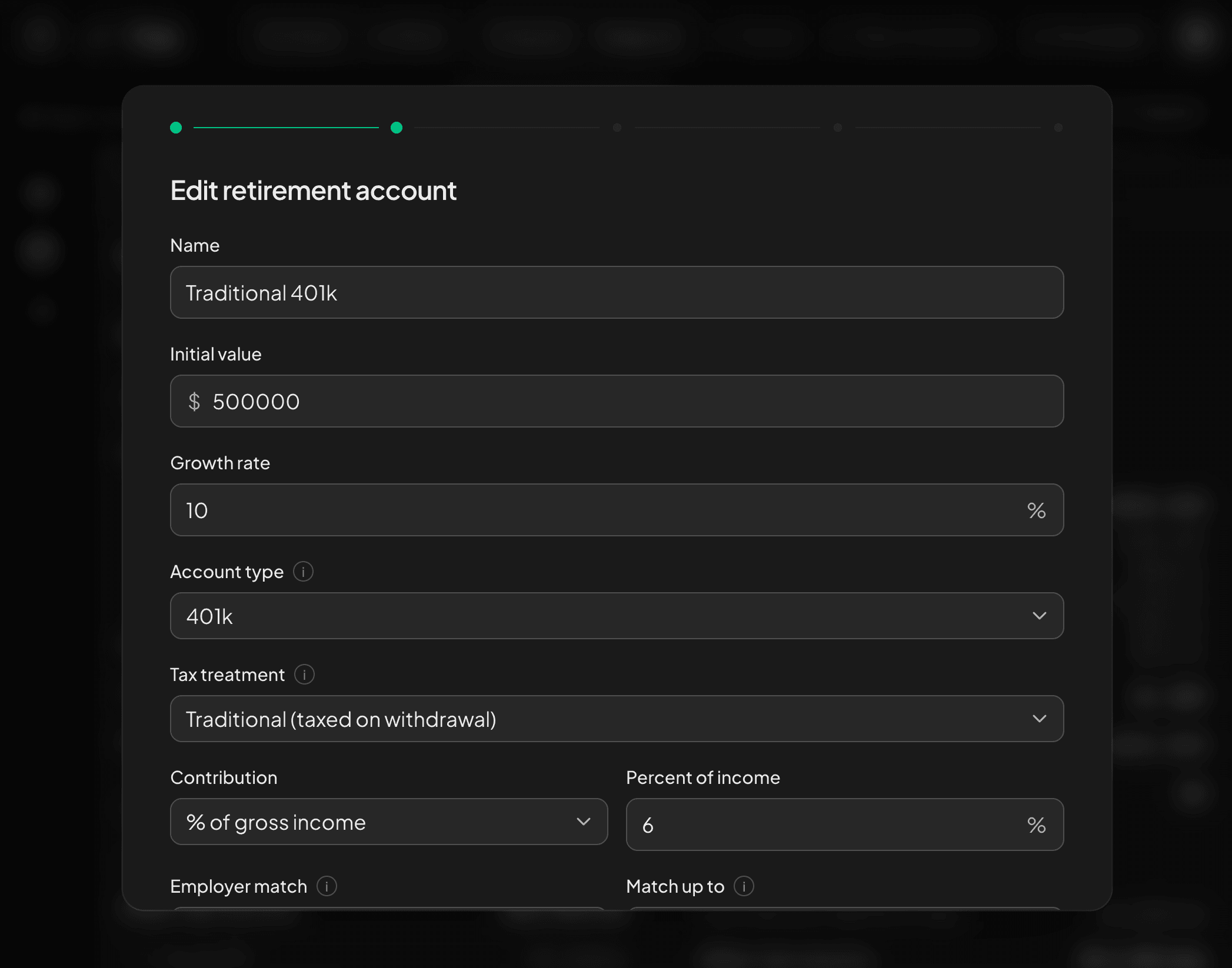
Sofia is 48 and earns $210,000, which lands her in the 24% federal bracket. Like a lot of people, she saves through her 401(k), 6% of her pay with a 50% match, and spends the rest of her paycheck. She already has $500,000 in the account and figures she’ll spend around $90,000 a year once she retires. Her instinct says traditional, the grown-up default for a solid earner, so she builds it both ways in ifso to be sure.
With advanced tax mode on, the two scenarios differ by exactly one setting, the account’s tax treatment, with the same 6% going in either way.
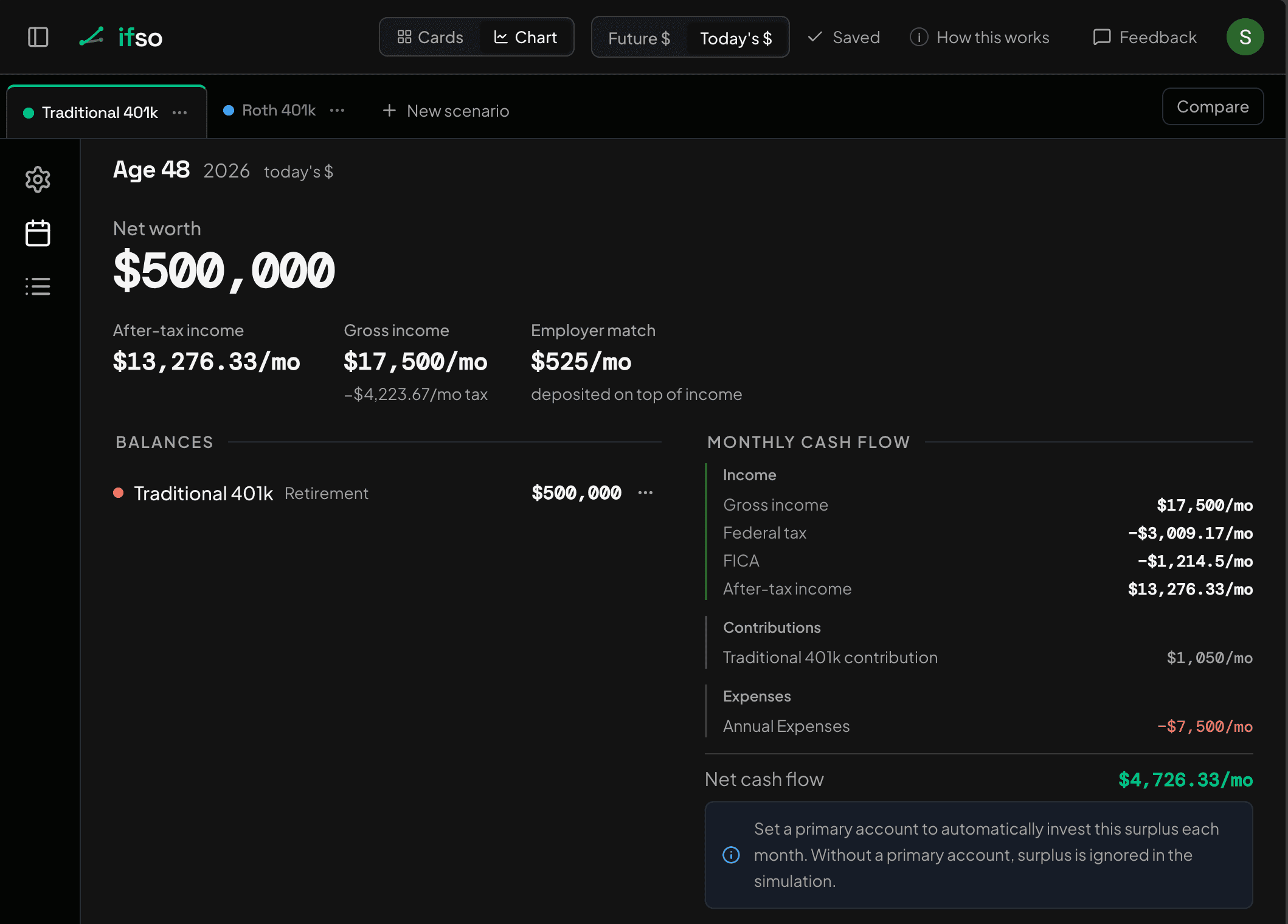
The traditional scenario. Her 6% comes off her taxable income, and at 24% that trims her federal tax by about $250 a month, a little more take-home right now. You can watch it land in the tax line.
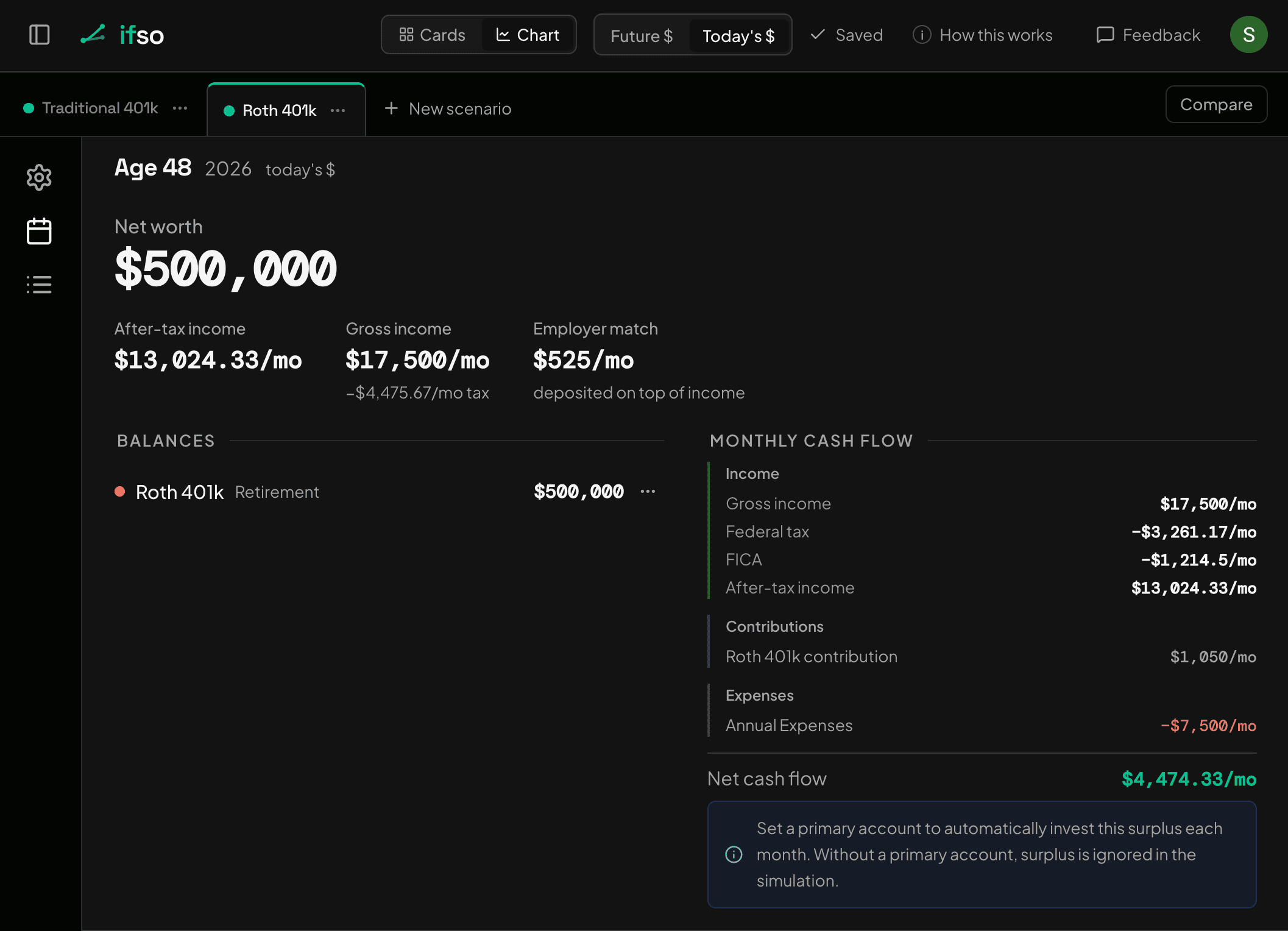
The Roth scenario. No break now, so she pays that $250 a month in tax instead and her take-home is a touch lower. But the account is tax-free from here on, and not one of her retirement withdrawals will ever owe a cent.
Run both to 90 and the answer is a surprise: Roth wins, and not by a little, about $661,000 more, $3.75M against $3.09M. Both plans fund her retirement comfortably. The Roth one just leaves far more behind.
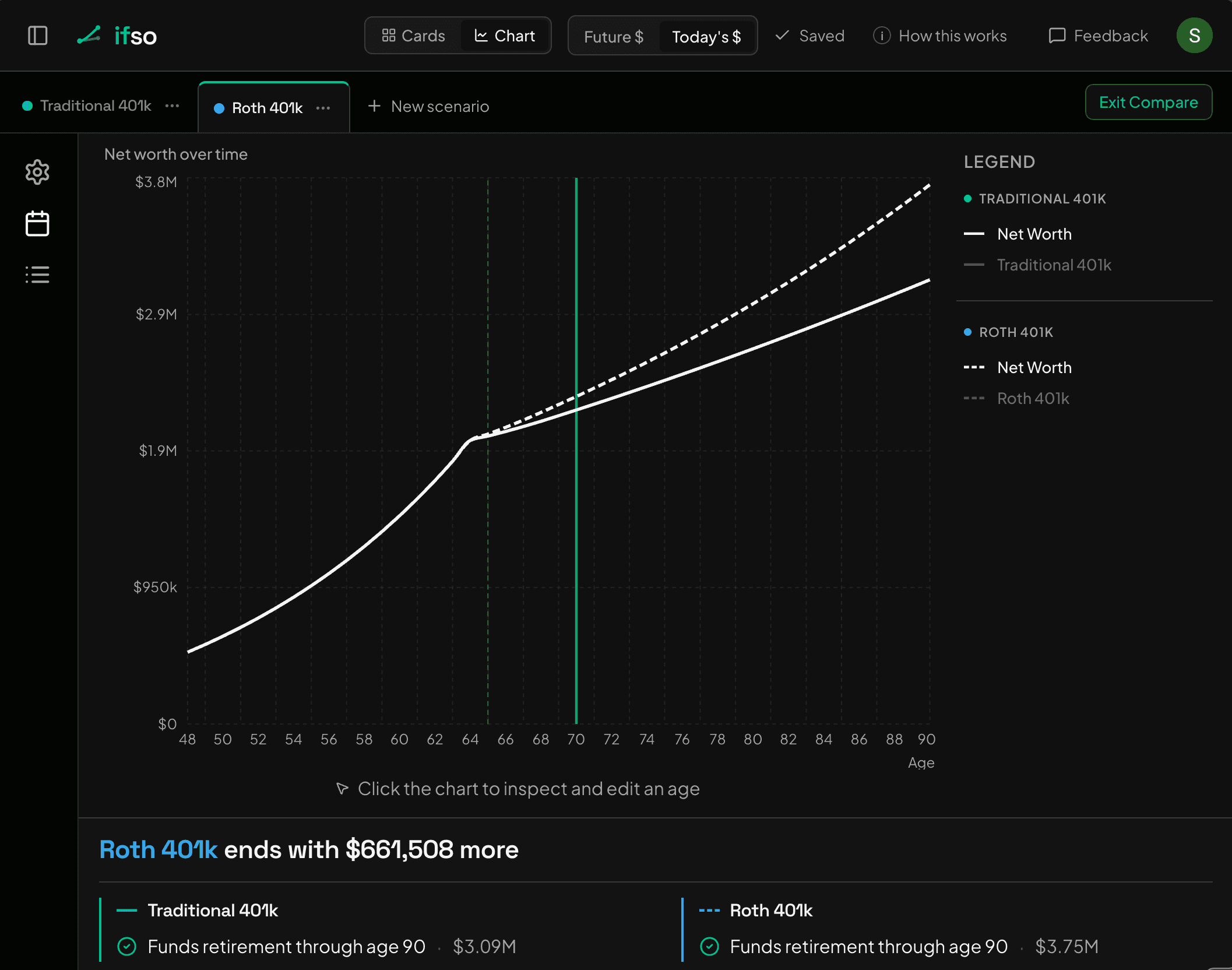
Two things drive that. First, Sofia never actually drops into a lower bracket: $500,000 compounding at 10% for two decades becomes a large pot, and drawing it down for a $90,000 lifestyle keeps her right around the same 24% rate, so there’s no gap for traditional to exploit. Second, and bigger, she isn’t investing the tax the deduction saves her. That $250 a month just becomes spending, so traditional gives back nothing while its withdrawals still get taxed. The Roth, by forcing the full after-tax amount into a shelter that never gets taxed again, comes out ahead.
So the one question still decides it, the rule is just stricter than it looks. Traditional only wins when two things are both true: your retirement rate really will be lower, and you’ll invest every dollar the deduction saves. Miss either, as a save-in-the-401(k)-and-spend-the-rest earner like Sofia does, and Roth is the safer bet. That’s the quiet reason “just do Roth” is decent default advice for a lot of people.
What changes the answer: income today, income in retirement
Everything here is really a version of the one question:
- Your rate now versus on your withdrawals later. This is the whole game, but read the second half carefully. A high income today doesn’t guarantee a lower rate in retirement: a big balance, drawn down for a comfortable lifestyle and stacked on top of Social Security, can land you right back in the same bracket. The wider the true gap, the more the winner wins.
- Whether you invest the tax break. Traditional’s edge is the tax it saves you now, and that only counts if the money goes to work instead of becoming spending. Set a primary account in ifso and the surplus is invested; if you know it would just become lifestyle, Roth’s forced full-amount saving is worth more than the bracket math alone suggests.
- Where your retirement income comes from. Social Security, a pension, and required withdrawals from big traditional balances all stack up as taxable income later, and can push your retirement bracket higher than you’d expect. The more of that you’ll have, the better Roth looks.
- Tax diversification.Holding some of each hands you a dial in retirement: draw from the traditional account up to the top of a low bracket, then top up tax-free from the Roth. If you genuinely can’t tell which rate will be lower, splitting is a defensible answer, not a cop-out.
- Whether you’re maxing out. At the contribution limit, Roth shelters more real money, since the cap is a dollar amount and a Roth dollar has already paid its tax. For heavy savers that’s a thumb on the scale toward Roth.
- Where you think rates are headed. Today’s brackets are what ifso projects forward. If you believe tax rates will rise over your lifetime, paying now with a Roth locks in a rate you may not see again.
Model your own contributions
It takes a few minutes and no linked accounts. The trick is to change only the tax treatment between the two scenarios, so the comparison is clean:
- 1Switch to advanced tax mode and enter your income and filing status, so the brackets ifso uses are your real ones.
- 2Add your 401(k) or IRA with your actual contribution, and set the employer match if you have one so the match is captured first.
- 3Set the account’s tax treatment to traditional and note both this year’s tax and the retirement outcome.
- 4Clone the scenario, flip the treatment to Roth, and keep the contribution exactly the same.
- 5Be honest about the tax break: if you’d truly invest what a traditional account saves you, set a primary account so that surplus is invested in both scenarios; if you’d spend it, leave it unset. That one choice can decide the whole comparison.
- 6Compare the two, reading the after-tax retirement picture rather than the raw balances, and nudge your expected retirement spending to see how solid the answer really is.
Not sure what your retirement will actually cost, which is the number this whole decision turns on? Start there: when can I actually retire?
Now run your own numbers.
Try it free, no sign-upOpens right in your browser with a sample plan ready to edit, with no account needed. No email, no credit card. Create an account only if you want to keep your plan.